Why Your Skin Is Breaking Out After 40
You are standing in the bathroom at 47, 52, or 55, staring at a cluster of deep, cystic breakouts along your jawline — and feeling a specific, exhausted frustration. Not because of vanity, though the world will try to tell you that is the problem. Because you have done everything right. You cleansed gently, you moisturised, you stopped using the harsh products that worked at 22. And still, your skin is doing something it has not done in decades, or something it has never done before, and nobody has given you a satisfying explanation for why.
Adult female acne affects approximately 26% of women in their forties and 15% in their fifties. That is not a small number. What the statistic does not convey is how completely unprepared most women are for it, or how routinely they are dismissed when they raise it with a doctor whose blood tests come back normal.
Key Takeaways (For When You Are Skimming Between Meetings)
- Menopausal acne is driven by a shift in the estrogen-to-androgen ratio, not a spike in androgens — most women’s androgen levels remain within normal range. The balance changes because estrogen falls.
- SHBG, the protein that holds free testosterone inactive, declines with estrogen — so more testosterone reaches sebaceous glands even when total testosterone looks unremarkable on a blood test.
- Much of the androgen activity in menopausal acne happens inside the sebaceous glands themselves (intracrine metabolism), which means standard blood panels can return normal results while the skin remains actively driven by androgens.
- Estrogen decline reduces collagen density by an estimated 30% in the first five postmenopausal years — which is why a breakout at 50 leaves a prolonged mark even when the acne itself is not severe.
- Progesterone may begin declining several years before measurable estrogen changes — making early perimenopause a plausible time for skin changes that most clinical conversations will not connect to hormonal transition.
- Elevated insulin suppresses SHBG and stimulates IGF-1, both of which amplify androgen-driven sebum production — meaning metabolic factors may operate as an independent acne amplifier alongside hormonal change.
In this article
- The Hormonal Cascade: What Actually Causes Menopausal Acne
- Estrogen Decline and the Relative Androgen Shift
- The DHEA-S Factor: Why Blood Tests Often Miss the Real Story
- Androgen Receptor Sensitivity: What Blood Tests Cannot Measure
- The Progesterone Piece
- Why Perimenopause Acne Isn’t Teenage Acne
- Why Midlife Acne Is Not One Condition
- The Metabolic Amplifier
- The Emotional Weight — and Why It Matters Clinically
- Treating Hormonal Acne Over 40: What the Science Actually Supports
- Why products designed for adolescent acne are likely to make things worse
- Retinoids: evidence and caveats
- Hormone therapy and acne
- The multi-layered picture
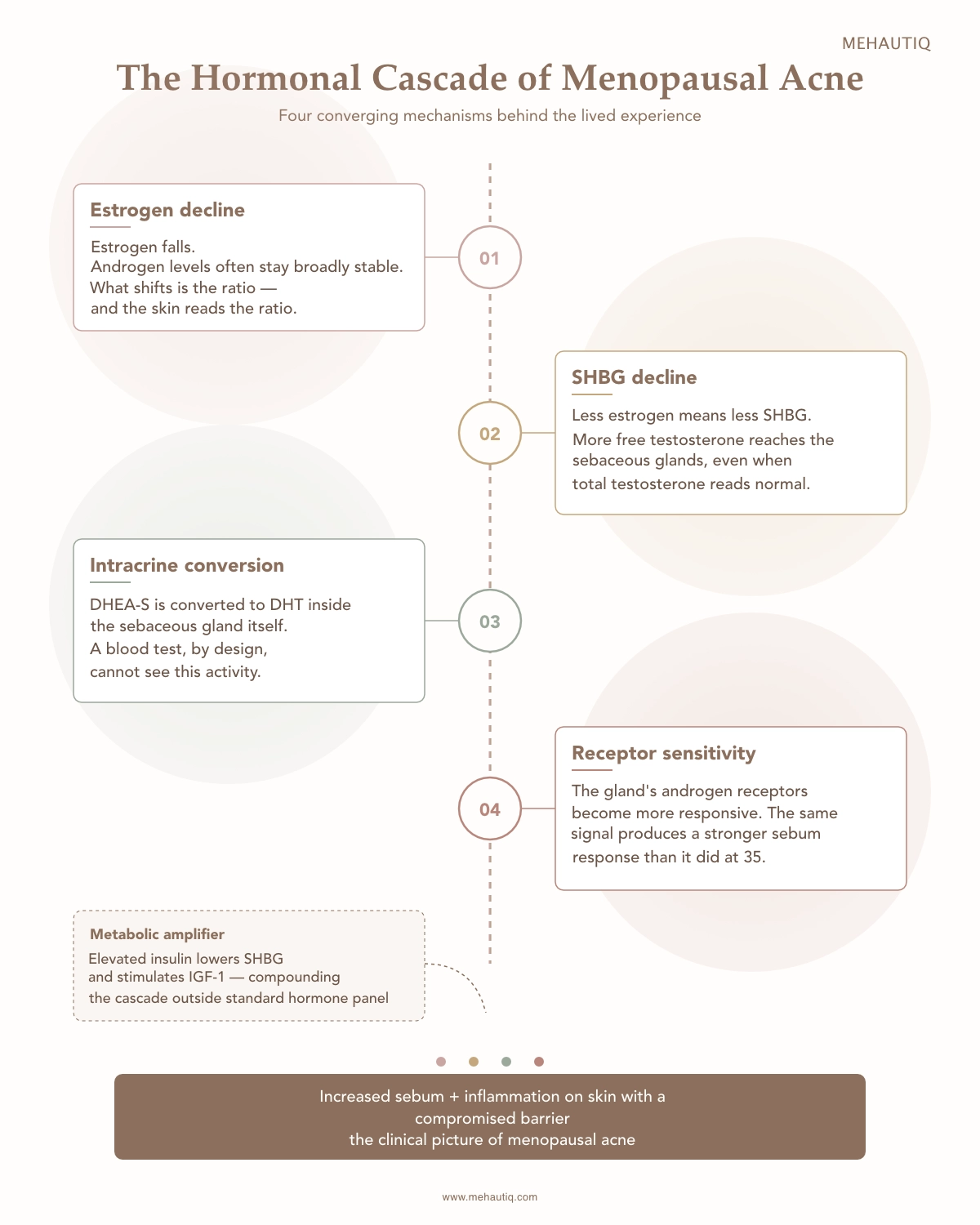
The Hormonal Cascade: What Actually Causes Menopausal Acne
The popular explanation of menopausal acne goes something like this: “Your hormones are all over the place.” This is technically true and practically useless.
What is actually happening is more specific — and once you understand the mechanism, the clinical picture your skin is presenting begins to make sense in a way that “hormonal imbalance” never quite did.
Estrogen Decline and the Relative Androgen Shift
Estrogen and androgens (a group that includes testosterone) have always existed in your body in a ratio. Estrogen is the dominant sex hormone in reproductive-age women, and it does several things in skin that matter directly to acne: it regulates sebum production, supports the structural integrity of the skin barrier, and modulates the activity of oil-producing sebaceous glands. It also has direct anti-inflammatory effects on skin tissue — meaning it actively suppresses the kind of low-grade inflammation that makes a blocked pore into a lesion.
As perimenopause begins, estrogen production from the ovaries becomes irregular and, eventually, substantially lower. What this means for your skin is not that your testosterone suddenly spikes. For most women, androgen levels do not rise dramatically during the perimenopause — they may even decline slightly with age. What changes is the ratio. With estrogen falling, androgens that were previously counterbalanced now have a disproportionate influence on sebaceous gland activity, even if their absolute level would look unremarkable on a lab report.
The lab result is answering a different question than the one your skin is asking.
Estrogen also regulates sex hormone-binding globulin (SHBG) — a protein that acts as a molecular chaperone in the bloodstream. Think of SHBG as a sponge that soaks up free testosterone in your bloodstream, keeping it from reaching your skin’s oil glands. Estrogen stimulates the liver to produce this sponge. As estrogen falls, the sponge shrinks — and more free testosterone is left circulating, available to act on sebaceous gland receptors.
As estrogen falls, SHBG levels also decline. More free testosterone becomes available to reach the sebaceous glands and stimulate oil production — not because more testosterone was made, but because less of it is being held. This distinction matters clinically, and it matters for you: it is why a standard hormone panel showing “normal” total testosterone can coexist with skin that is actively breaking out.
The DHEA-S Factor: Why Blood Tests Often Miss the Real Story
There is a second mechanism operating simultaneously, and it helps explain something that frustrates many women who have pursued testing: why even a comprehensive blood panel can leave their dermatologist shrugging.
Picture this: you have been breaking out consistently for eight months. You ask for hormone tests. The results come back. Everything looks within normal range. You are told, perhaps kindly, perhaps not, that hormones are not the issue. You leave the appointment with a prescription for a topical retinoid and a vague sense of not being believed — or, worse, of your own experience being implicitly questioned.
What that conversation likely did not include is the mechanism that follows.
The adrenal glands continue producing a hormone called dehydroepiandrosterone sulfate (DHEA-S) throughout and beyond the perimenopause, largely independent of ovarian hormone decline. DHEA-S is not itself androgenic — but the sebaceous glands and hair follicles in the skin are capable of converting it into active androgens locally, on-site, without any of those androgens ever appearing at elevated levels in the bloodstream.
The sebaceous glands function, in this context, like a kitchen that does its own cooking. The raw ingredients arrive (DHEA-S), and the conversion to the finished product (active dihydrotestosterone, or DHT — the most potent stimulant of sebum production) happens locally, in the gland itself, through a process called intracrine metabolism. A blood test measures what is circulating. It does not measure what is being manufactured inside the gland.
The research showed that both insulin-like growth factor-1 (IGF-1) and DHEA-S levels can be higher in adult women with acne than in age-matched controls without it, thus validating the hormonal mechanism in women whose test results appeared normal. In other words, a normal blood result does not mean that hormones are not causing your breakouts. It means the driving factor is present somewhere that the test was not designed to detect.
This also means that “your hormones are normal” and “your skin is hormonally driven” are not contradictory statements. Understanding this distinction makes it possible to pursue the conversation further — and to understand why a test that looked for hormones in the bloodstream may simply have been asking the wrong location.
If you have been told your hormones are fine and therefore your skin problem is not hormonal — that conversation deserves to be revisited.
Androgen Receptor Sensitivity: What Blood Tests Cannot Measure
Here is the part that many clinicians do not discuss, because it is harder to test and harder to treat: androgen receptor sensitivity.
Even if your circulating androgen levels and your intracrine androgen production were both within a normal range, your skin could still be responding to those androgens more strongly than it did a decade ago. The volume on the hormonal signal — what is being transmitted — may be unchanged. What has shifted is the amplifier: the receptor in the sebaceous gland that receives the signal.
An analogy that may help: imagine the same piece of music played through two different speaker systems at the same volume setting. One produces a moderate sound; the other amplifies it significantly. The input — the music, the volume dial — is identical. The difference is in the speaker’s sensitivity. Androgen receptor sensitivity works the same way. The hormonal signal arriving at the sebaceous gland is not necessarily louder. The gland has become more responsive to whatever signal arrives.
A 2025 systematic review by Telkkälä and colleagues confirmed that in some adult women, sebaceous gland and keratinocyte receptors react to even low androgen levels, helping explain acne in women with normal-range hormone results. Khunger and Mehrotra (2019) link increased receptor sensitivity in the postmenopausal period to the relative androgen excess that follows estrogen decline. This means the same level of androgen drives a stronger sebum-production response than it would have at 35. It also helps explain why some women experience significant menopausal acne while others, with broadly similar hormone profiles, do not: individual variation in receptor sensitivity is real, measurable in research settings, and almost entirely absent from standard clinical assessment.
If you are the woman who has watched a friend sail through the perimenopause with clear skin while your skin has behaved as though it is waging its own campaign — receptor sensitivity, not moral failing or inferior skincare choices, is most likely part of the explanation.
No standard blood panel is designed to measure this. And knowing that — rather than treating the normal result as the end of the conversation — changes how usefully you can engage with the clinical process.
On the question of reversibility: the evidence is preliminary. What the research does suggest is that receptor sensitivity is not a fixed biological constant — it appears to be modulated by the hormonal environment, which means it is, in principle, a dynamic rather than permanent state. The practical implications of this are still being investigated, and it would be imprecise to offer firm conclusions. What the emerging picture does not support is the assumption that this mechanism is untreatable simply because it is unmeasurable by current standard tests.
The gap between what a blood panel can detect and what is actually driving your skin is the science’s limitation, not an indication that nothing is happening.
The Progesterone Piece
Progesterone is rarely the first hormone discussed in the context of menopausal acne, which is unfortunate, because its decline often precedes estrogen’s by several years — making it relevant to women in their early forties who are being told, sometimes repeatedly, that they are “too young for menopause.”
Natural progesterone is sometimes described as having a mild anti-androgenic effect at skin androgen receptors, although the current evidence base concerns synthetic progestins (notably cyproterone acetate and drospirenone) used in combined oral contraceptives rather than natural progesterone itself. Whether body-identical progesterone — including the micronised oral form (Utrogestan) prescribed within HRT — shares this effect remains under investigation, and is a question worth raising with a prescribing clinician if acne is a concern.
What is clearer is the sequencing. Progesterone is typically the first of the major reproductive hormones to fall as ovulation becomes irregular, often several years before estrogen begins its sharper decline. A woman whose skin suddenly changes at 42, and who is told by everyone around her that she is too young for menopause, may in fact be observing one of the earliest hormonal signatures of the transition — not the dramatic estrogen drop that arrives later, but the quieter progesterone shift that precedes it.
Why Perimenopause Acne Isn’t Teenage Acne
Understanding that hormones are the mechanism is one part of the picture. The other part is understanding why the resulting acne looks and behaves differently from the acne you may have had at 16, 25, or even 35.
That paradox — skin that is simultaneously drier and breaking out — is not a failure of your skincare routine. It is the biology of the perimenopause, working through two parallel processes at once.
Estrogen plays a central role in maintaining the skin barrier: specifically, it supports the production of ceramides, fatty acids, and other lipids that form the barrier’s structural integrity. It also stimulates hyaluronic acid production and collagen synthesis. As estrogen falls, the barrier becomes thinner, drier, and more permeable — meaning the skin loses water more easily, reacts more readily to products that previously caused no irritation, and heals more slowly.
Here is a specific implication that many women are not told: the loss of skin collagen — estimated at roughly 30% in the first five postmenopausal years, means that a single breakout at 50 can leave a mark that takes months to fade.
This is not because the breakout was more severe. It is because the skin’s repair capacity has changed. The “acne scar” you are seeing is often not scar tissue at all — it is post-inflammatory hyperpigmentation on skin that no longer resolves pigment quickly. Understanding this distinction matters because it affects which approaches are and are not appropriate to address it.
Meanwhile, sebaceous glands remain androgenically stimulated, continuing to produce sebum even as the surrounding skin becomes barrier-impaired and drier. Breakouts have classically been described along the jawline, chin, and lower cheeks — anatomical areas with a high density of androgen-sensitive follicles — though more recent observational work (Khunger and Mehrotra, 2019) suggests this distribution pattern is less universal than long assumed, with lesions in fact appearing across all facial zones in most women. What remains consistent is the underlying paradox: active sebum production on a face that is simultaneously flaking, sensitive, and dry elsewhere.
The acne is generally not more severe in terms of lesion count than adolescent presentations, but menopausal acne is more often treatment-resistant and more readily produces post-inflammatory pigmentation and scarring. It is happening on fundamentally different skin — with compromised barrier function, slower healing, reduced collagen density, and altered pigment resolution. Treating it as though it were the same condition is why so many standard approaches make it worse.
Why Midlife Acne Is Not One Condition
Perimenopausal acne and postmenopausal acne share hormonal drivers but operate through different hormonal dynamics — and this distinction has meaningful implications for how the skin behaves and what approaches are likely to be useful.
During perimenopause, hormone levels are volatile. Estrogen does not decline in a straight line; it fluctuates, sometimes surging and then falling sharply within a single cycle. This volatility means the skin can shift rapidly — clear for two weeks, then actively breaking out. The unpredictability itself is part of the mechanism, because sebaceous glands respond to relative changes in hormonal signalling, not just to absolute levels.
A woman in this phase may find that her acne appears to have no pattern, responds inconsistently to the same product, and seems to worsen at certain points in what remains of a cycle. That inconsistency is, in its way, diagnostic.
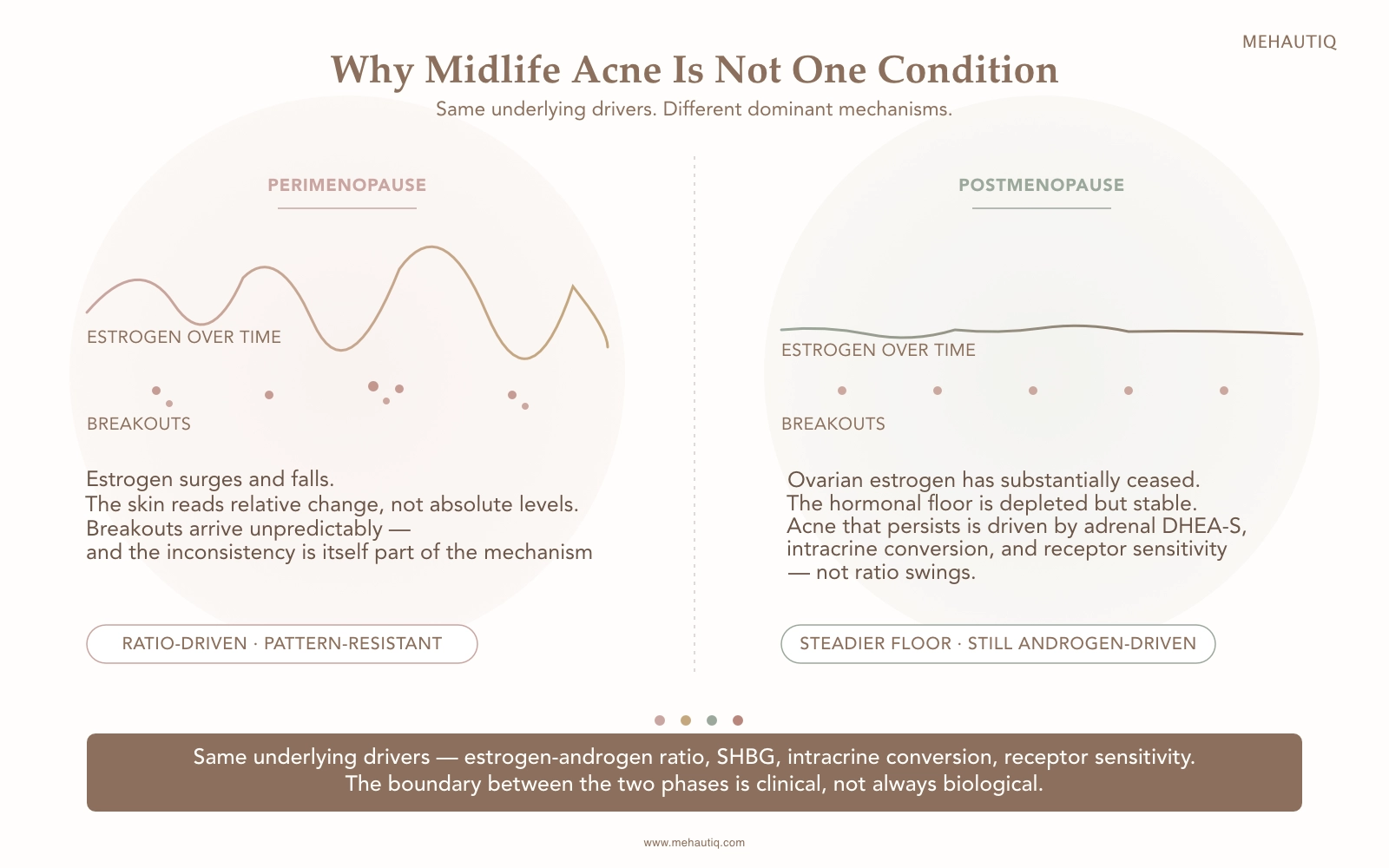
After the menopause — defined as twelve consecutive months without a period — ovarian estrogen production has substantially ceased. Hormonal volatility generally reduces, replaced by a more stable (though significantly depleted) hormonal environment. Acne that persists into the postmenopausal years tends to be driven more by the adrenal DHEA-S pathway, intracrine androgen metabolism, and receptor sensitivity than by the estrogen-androgen ratio fluctuations that characterise perimenopause. For some women, postmenopausal acne becomes more predictable in timing and location, even if it does not resolve. That stability — if it is what you are experiencing — is itself informative about which part of the mechanism is dominant.
The two conditions can also overlap. Some women are technically postmenopausal by definition (twelve months without a period) but retain enough residual hormonal volatility, or have sufficient adrenal DHEA-S production, that their skin continues to behave as though the transition is still in progress. The boundary is clinical, not always biological.
Understanding which phase is more likely operating for you shapes the questions worth asking a clinician — which will be examined in detail in the next article in this series.
The Metabolic Amplifier
There is a third pathway that the standard explanation of menopausal acne rarely discusses, despite appearing consistently in the research: the relationship between insulin, androgens, and sebum production.
Insulin — specifically elevated fasting insulin, associated with insulin resistance — stimulates androgen production through two mechanisms. First, it increases androgen synthesis directly in the ovaries and adrenal glands. Second, it suppresses SHBG, the protein discussed earlier that holds free testosterone in an inactive state. Lower SHBG means more free testosterone available to reach the sebaceous glands.
Elevated insulin also stimulates IGF-1 (insulin-like growth factor-1), which directly promotes both sebum production and the abnormal follicular cell growth that leads to comedones — blocked pores.
The PCOS (polycystic ovary syndrome) literature is instructive here, because PCOS-related acne has been studied more extensively than menopausal acne, and it operates through the same insulin-androgen-sebum pathway. Findings from this body of research illuminate mechanisms that apply well beyond PCOS itself — including in women who have never had a PCOS diagnosis and whose acne begins in their forties.
The perimenopause is itself associated with a shift in metabolic function. Estrogen plays a role in maintaining insulin sensitivity, and declining estrogen production contributes to changes in how the body processes glucose and stores fat — changes that may, in turn, amplify the hormonal drivers of acne through the insulin pathway. The direction of causality in the estrogen-insulin sensitivity relationship is still being investigated, and it would be imprecise to present it as a settled mechanism. What the evidence does support is that the two systems interact, and that the interaction matters for skin.
What this means practically is that menopausal acne may have metabolic contributors that sit entirely outside what a standard hormonal panel measures — which is one of several reasons why that panel, on its own, is an incomplete diagnostic tool for this presentation.
The Emotional Weight — and Why It Matters Clinically
Dismissing the emotional dimension of menopausal acne as vanity would be a clinical error, not just an empathic failure.
Quality-of-life studies in adult women with acne (Tan et al. 2021; Tanghetti et al. 2014) report impairment levels comparable to those seen in chronic dermatological conditions, and significantly higher than typically reported in adolescent populations. The same five breakouts carry different weight at 48 than they did at 16, because they arrive in a different life context — one in which your face is the surface through which professional authority, personal identity, and social confidence are all negotiated daily.
This is not a statement about superficiality. It is a statement about the specific conditions of midlife for women in professional and public-facing roles, and about the way visible skin changes in this demographic interact with how women are perceived and how they perceive themselves.
There is also a direct physiological loop worth understanding. Psychological stress activates the HPA axis, which triggers the release of corticotropin-releasing hormone (CRH) — a hormone that directly stimulates sebaceous gland activity and promotes inflammation in the skin. The perimenopause is itself a physiologically stressful transition. Sleep disruption, vasomotor symptoms, and the cognitive and emotional demands of midlife compound baseline cortisol load.
The result is a feedback mechanism: acne causes stress, and stress, through CRH signalling, worsens acne. Acknowledging this loop is not the same as suggesting the acne is psychosomatic. The mechanism is hormonal and inflammatory. It simply runs in both directions.
Stress reduction is included in clinical guidance on adult and menopausal acne management as part of broader lifestyle measures, with a recognised biological pathway linking stress hormones to sebaceous gland activity.
Treating Hormonal Acne Over 40: What the Science Actually Supports
The science covered in this article has one direct practical implication: topical treatment alone is operating on the surface of a problem that is primarily hormonal and, in part, metabolic. For women in active perimenopause with ongoing hormonal fluctuation, that is a significant limitation — not a reason to abandon topical care, but a reason not to expect topical care to resolve the underlying driver.
Why products designed for adolescent acne are likely to make things worse
Products formulated for teenage skin are built for a specific biological context: high sebum production, a resilient and well-functioning skin barrier, strong wound-healing capacity, and androgen-dominant hormonal activity. The active ingredients in these formulations — typically high concentrations of benzoyl peroxide, alcohol-based carriers, or aggressive surfactants — are calibrated for that biology. On menopausal skin, where the barrier is already compromised, healing is slower, and the inflammatory response to irritation is amplified, these same concentrations frequently trigger barrier breakdown, reactive sebum production, and worsening inflammation.
If you have had the experience of applying a well-reviewed acne product to your face, watching your skin become inflamed and reactive within days, and concluding that you are somehow doing skincare wrong — the product was wrong, not your technique. The problem is not the ingredient class. It is the concentration and formulation context, applied to skin with a fundamentally different biological profile.
Retinoids: evidence and caveats
Retinoids are among the most studied topical actives for acne and comedone formation, with a substantial evidence base across age groups. However, as Khunger and Mehrotra (2019) noted, the age-specific evidence for retinoid use in menopausal acne is considerably thinner than for adolescent presentations. The mechanism by which retinoids work — normalising follicular cell turnover and reducing comedone formation — remains relevant in midlife acne. But the application context matters: menopausal skin with a compromised barrier requires lower concentrations, buffering approaches, and attention to hydration in a way that standard retinoid protocols often do not account for. Using a retinoid without addressing barrier function first may worsen sensitivity before improving the acne.
Hormone therapy and acne
Hormone replacement therapy can influence menopausal acne through several of the mechanisms described in this article — specifically by partially restoring the estrogen counterbalance, raising SHBG levels, and (depending on the progestogen component) modulating androgen activity in the skin. The evidence for this is moderate, not definitive; responses vary significantly depending on the specific formulation, the route of administration, and the individual’s hormonal baseline. The progestogen choice within an HRT regimen is particularly relevant — some synthetic progestins have androgenic properties that can worsen acne, while others have anti-androgenic profiles that may improve it. This is a conversation that belongs between a woman and her prescribing clinician, with acne explicitly on the agenda.
The multi-layered picture
The science of menopausal acne points toward a situation where no single approach addresses all the relevant drivers simultaneously. The hormonal component, the barrier component, the inflammatory component, and the metabolic component each respond to different interventions. Topical care, hormonal treatment, and metabolic considerations each address different parts of the mechanism described above.
What is consistent across the evidence is that sequence matters. Addressing barrier function is not an optional cosmetic preliminary — it is a precondition for other interventions to work without causing additional damage. A skin barrier that is stripped or reactive will not absorb actives predictably, will not heal breakouts efficiently, and will report worse outcomes from treatments that might work well on intact skin.
Which combination is appropriate — and in what sequence — depends on the individual’s hormonal phase, skin barrier status, and medical history. No general framework can assess that for a specific person; it is a question that belongs in a clinical conversation, with enough of the underlying science to ask the right questions.

Researched and written for MEHAUTIQ by Dorota Weiss
Cosmetic formulator trained at Formula Botanica (Advanced Diploma in Organic Cosmetic Science), with an academic research background. Every article is built on peer-reviewed studies read at source, and says plainly where the evidence ends.
Literature
- Brincat M, A study of the decrease of skin collagen content, skin thickness, and bone mass in the postmenopausal woman, Obstet Gynecol. 1987 Dec;70(6):840-5.
- Castelo-Branco C, Duran M, González-Merlo J. Skin collagen changes related to age and hormone replacement therapy. Maturitas. 1992;15 (2):113–119.
- Cappel M, Mauger D, Thiboutot D. Correlation between serum levels of insulin-like growth factor 1, dehydroepiandrosterone sulfate, and dihydrotestosterone and acne lesion counts in adult women. Arch Dermatol. 2005 Mar;141(3):333-8. doi: 10.1001/archderm.141.3.333.
- Ganceviciene R. Et all., Involvement of the corticotropin-releasing hormone system in the pathogenesis of acne vulgaris. Br J Dermatol. 2009 Feb;160(2):345-52. doi: 10.1111/j.1365-2133.2008.08959.x.
- Khunger N, Mehrotra K. Menopausal acne — challenges and solutions. International Journal of Women’s Health. 2019;11:555–567; doi: 10.2147/IJWH.S174292.
- Parkinson H,”Adult and perimenopausal acne and the nurse’s role in management” British Journal of Nursing, 2026 35;3: 145-152. doi.org/10.12968/bjon.2025.0559
- Tan J. Et al., Impact of facial and truncal acne on quality of life: A multi-country population-based survey. JAAD Int. 2021 Apr 27;3:102-110. doi: 10.1016/j.jdin.2021.03.002.
- Tanghetti E, Kawata A, Daniels S, et al. Understanding the burden of adult female acne. Journal of Clinical and Aesthetic Dermatology. 2014;7(2):22–30, DOI: 41373673
- Telkkälä A, Sinikumpu SP, Huilaja L. Etiology of Adult Female Acne-Systematic Review. Health Sci Rep. 2025 Apr 30;8(5):e70697. doi: 10.1002/hsr2.70697
- Zouboulis CC. Et al., Corticotropin-releasing hormone: An autocrine hormone that promotes lipogenesis in human sebocytes., Proc. Natl. Acad. Sci. U.S.A. 2002 99:10 7148-7153, https://doi.org/10.1073/pnas.102180999
- Galderma Press Release: Galderma tackles menopause-related skin changes with global survey and clinical trial inclusivity. 30.01.2026, https://www.galderma.com/news/galderma-tackles-menopause-related-skin-changes
- Letter to the Editor: LePillouer-Prost, A, et al. Skin and menopause: women’s point of view. J Eur Acad Dermatol Venereol, 2020 34: e267-e269. https://doi.org/10.1111/jdv.16242