There is a version of the conversation about menopausal acne that does not mention how it feels. It covers estrogen, androgens, sebaceous glands, barrier function. It is clinically accurate. And it misses, almost entirely, the reason most women are looking for information in the first place.
They are not searching primarily because they want to understand intracrine androgen metabolism. They are searching because they stood in front of a mirror this morning and felt something they cannot quite name. Not just frustration — something older and more complicated than frustration. A sense of wrongness. Of time running backwards in a direction they did not expect. Of a problem they had dealt with decades ago, returning to their face at the precise moment their face was already being asked to absorb too many other changes.
That dissonance is documented. It has been measured. And it belongs in the clinical picture.
The psychological dimension of menopausal acne is not a soft footnote to a dermatology article. It is, in multiple measurable ways, part of the pathology — with its own science, its own clinical implications, and its own place in a rational treatment strategy.
Key Takeaways (For When You Are Skimming Between Meetings)
- The quality-of-life impact of adult female acne is comparable to that of chronic systemic diseases — and greater than that of adolescent acne, despite typically fewer lesions. The same five breakouts carry different weight at 52 than at 16.
- The psychological burden is amplified at midlife because acne contradicts the expected timeline: it arrives without a cultural script, at a life stage already loaded with identity transitions.
- Stress does not just accompany acne — it influences it, through a measurable feedback loop in which cortisol and stress-signalling molecules directly stimulate oil production and inflammation. Addressing the emotional dimension is part of addressing the acne.
- The experience of feeling unheard by healthcare providers is documented, common, and structurally driven — arriving at consultations with a clear description of your condition and its hormonal context changes the dynamic.
- Separating the skin condition from the identity conclusions drawn from it is a psychologically grounded practice — not a platitude.
In this article
- A Quality-of-Life Impact Comparable to Chronic Disease
- Depression, Anxiety, and Stigma: The Numbers Behind the Experience
- The Lived Experience: What Women Actually Say
- The Convergence of Multiple Transitions
- When a Condition Doesn’t Fit the Expected Timeline
- The Feedback Loop: Stress Makes Menopausal Acne Worse
- The Cortisol-Sebum Connection
- Inflammation and Immune Signalling
- Being Heard, or Not
- The Dismissal Pattern
- What a Good Consultation Actually Looks Like
- What Women Can Do Now
A Quality-of-Life Impact Comparable to Chronic Disease
The statement that adult acne carries a quality-of-life burden comparable to chronic systemic diseases is not a metaphor or an exaggeration. It is a finding from validated measurement using tools — including the Dermatologic Life Quality Index (DLQI), the Acne-Specific Quality of Life questionnaire (Acne-QoL), and the Cardiff Acne Disability Index — that were designed precisely to make such comparisons.
Studies using these instruments have found that adult female acne produces DLQI scores similar to other chronic conditions such as asthma — conditions that involve significant systemic symptoms and that would never be described as merely cosmetic. The quality-of-life impairment of adult female acne is, by these measures, greater than that of adolescent acne, despite the fact that adult acne is frequently milder in terms of lesion count (Dias da Rocha et al. 2024, International Journal of Women’s Health).
Why does a milder condition produce a larger impact? That is precisely the question the research answers.
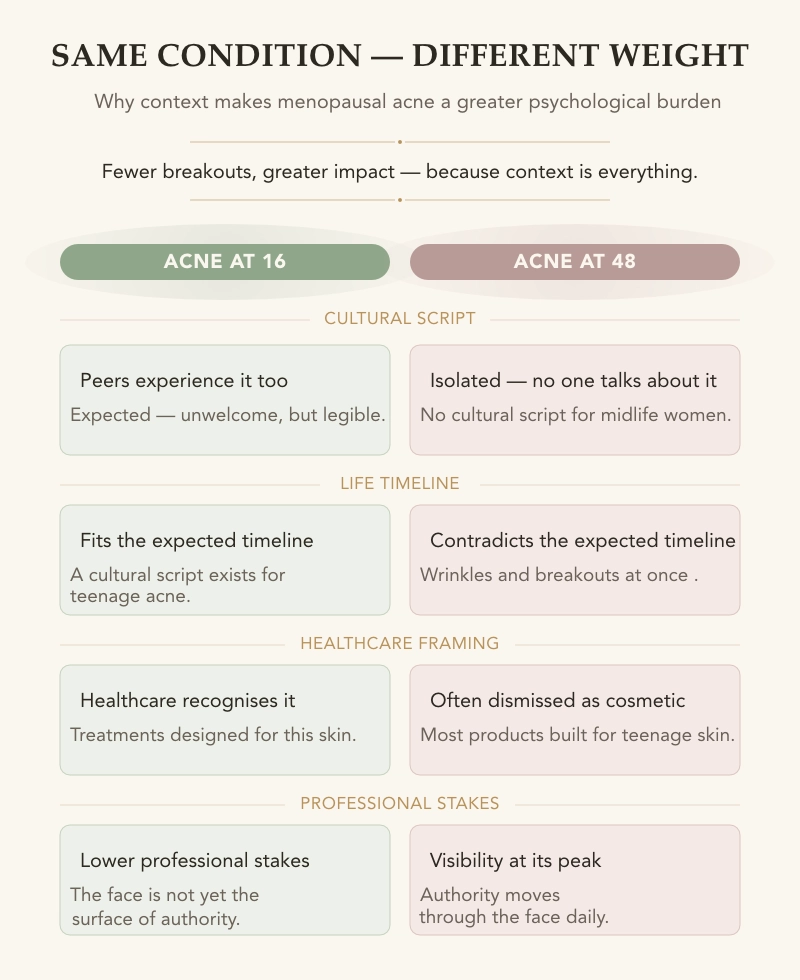
For an adolescent, acne is expected — unwelcome, painful, and stigmatised, but at least legible. It fits within a framework that teenagers and their families and their healthcare providers broadly understand. For a woman in her late 40s, acne is dissonant. It arrives without a cultural script. It contradicts the assumption that adult skin is stable and manageable. It appears at a life stage during which women are simultaneously managing demanding professional roles, frequently in positions where appearance is scrutinised, and often at a moment when other visible signs of ageing — fine lines, greying hair, shifting body composition — are already requiring psychological adjustment.
The same five breakouts mean something different at 52 than they did at 16. Not because they are objectively worse, but because they land on a life that has no ready-made place for them. That contextual amplification is what the DLQI scores are measuring. The distress is proportionate — to an experience whose full weight the lesion count alone cannot capture.
Depression, Anxiety, and Stigma: The Numbers Behind the Experience
The association between acne and psychological distress extends beyond general quality of life. Several studies have quantified specific psychiatric correlates — and the effect sizes are not trivial. If you have found yourself surprised by how heavily this is sitting on you — if the emotional response has felt larger than the condition seems to warrant — the research has something specific to say to that experience.
A 2025 study by Tunca and colleagues, published in the Journal of Cosmetic Dermatology, measured stigmatisation and psychosocial burden in acne patients aged 12 to 45. It found statistically significant correlations — meaning the relationships were strong enough to be unlikely due to chance — between acne-related stigmatisation and both depression and anxiety. These associations were observed across the full age range studied; the study did not find statistically significant differences between adolescent, late-adolescent, and adult age strata. The persistence of the association into adulthood is itself the finding worth holding onto — the burden does not resolve simply because the patient is no longer a teenager.
A separate study by Morshed et al., published in Scientific Reports in 2023, used validated instruments to measure the relationship between acne severity itself and psychological distress. The correlations were strong: stress (r = 0.758), anxiety (r = 0.661), and depression (r = 0.630) — relationships large enough to be considered clinically meaningful, not merely statistically detectable. Multiple regression analysis showed that acne severity and certain components of psychological distress — anxiety, depression, or stress, depending on which quality-of-life measure was used — independently predicted lower self-esteem and quality of life. The Morshed cohort included 150 patients aged 16 to 30, of whom 60% were female. Whether these associations are amplified further in the perimenopausal decade, where hormonal volatility and identity transitions compound the acne-specific burden, has not yet been confirmed by a study targeting that population directly.
A correlation of 0.758 between acne severity and stress means that the dermatological and the psychological dimensions are not merely co-occurring. They are deeply entangled — the severity of what is on the skin and the severity of what is felt about it move together, closely. For the woman who feels that her acne is making everything else harder — her mood, her confidence, her willingness to be visible — the research confirms that this experience is grounded in documented physiology.
The Lived Experience: What Women Actually Say
Numbers document burden; qualitative research illuminates what that burden actually looks like in daily life. The most detailed qualitative investigation of the lived experience of adult female acne is a study published in JAMA Dermatology, which analysed structured interviews with 50 adult women with acne aged 18 to 40 (Barbieri et al. 2021, JAMA Dermatology). The themes that emerged are broadly consistent with what midlife women report in clinical and community settings.
The themes were strikingly consistent:
Social withdrawal. Multiple participants described limiting or avoiding social activities because of acne. One described not leaving her house without a full face of makeup; another described cancelling plans when her skin was particularly bad. The withdrawal extended beyond casual social events to professional settings — presentations avoided, video calls declined, in-person meetings dreaded. If you have ever turned off your camera or rearranged your day around your skin, the research confirms this is one of the most consistently reported functional impacts of adult acne.
Professional impact. Participants described feeling that they were not taken as seriously in professional contexts because of their skin. The asymmetry — expected to project confidence and competence while managing a condition that undermines both — was a recurring theme. For women at midlife, where professional visibility and authority are often at their peak, the dissonance between that identity and what is happening on the skin’s surface may be particularly acute.
The hours spent. Participants described spending an hour each morning on makeup application, concealment strategies, and product management — a daily practice of covering what they felt they could not show. Tallied across months and years, that is a significant cost in time, energy, and attention — paid before the workday has even begun.
The dismissal experience. Perhaps the most clinically significant theme was the feeling of not having been heard. Participants described healthcare encounters in which their acne was characterised as cosmetic, in which their emotional distress was acknowledged only briefly or not at all, in which they were given general advice that did not account for the hormonal context of their condition. A substantial proportion described stopping seeking medical help because the experience of seeking it and feeling unheard was itself distressing.
The Convergence of Multiple Transitions
The psychological weight of acne in the perimenopausal and menopausal years is amplified by the convergence of multiple simultaneous transitions — not just hormonal, but existential.
The perimenopausal decade is, for many women, a period of compressed identity renegotiation. Professional identity, parental identity, the relationship with the body and with ageing, the re-evaluation of what the second half of life might look like — these do not arrive in sequence. They arrive together. Research on life transitions in midlife women describes this convergence as one of the defining features of the period: the sense that multiple self-concepts are in motion simultaneously, with no stable ground. Acne arrives in the middle of this renegotiation as a deeply unwelcome disruption.
The face is the primary site of both identity expression and social legibility — the surface through which a woman is seen, recognised, and responded to. Changes to the face at midlife — whether the anticipated ones (lines, shifts in skin texture, the beginning of volume loss) or the unexpected ones (new breakouts, deep nodules along the jawline, persistent pigmentation from healed lesions) — are experienced by many women not merely as aesthetic events, but as identity events. For many at midlife, the face is where the convergence becomes visible.
The woman who finds herself spending extra time on concealment at 51 is not merely managing a skin condition. She is managing the gap between her internal sense of self and the external presentation she used to have greater control over.
When a Condition Doesn’t Fit the Expected Timeline
Psychologists studying the experience of ageing have documented a pattern worth understanding here: we tend to tolerate age-related physical changes most readily when they feel appropriate to our stage of life. Greying hair at 55 carries a different psychological weight than greying hair at 28, because it fits the expected trajectory. The age-congruence of a physical change shapes how we respond to it — a finding supported by research on the psychological processing of normative versus off-time health events.
Acne at 52 — a condition associated in most cultural scripts with adolescence — disrupts this sense of appropriateness so completely that it produces a quality of distress that feels disproportionate but is, in fact, precisely calibrated to its social and developmental context: the condition is genuinely anomalous, the absence of any cultural script for managing it is real, and the disorientation that follows is an accurate response to that absence.
Women describe this explicitly: the strangeness of finding oneself simultaneously concerned about wrinkles and breakouts. The incongruity of a condition associated with teenagers appearing at an age when one’s children may be teenagers. In online communities, qualitative researchers and community observers have noted that this sentiment — the feeling that one should be past this — is one of the most consistently expressed themes, reflecting not self-criticism but genuine disorientation at a condition that fits no available narrative.
This disorientation is not irrational. It reflects a real absence: there is almost no cultural representation of midlife women with acne, no public narrative, no widely available framework for understanding what is happening or how to respond to it. The silence around menopausal acne is itself part of the burden.
The Feedback Loop: Stress Makes Menopausal Acne Worse
The Cortisol-Sebum Connection
Picture a morning when acne has already shaped the first hour — the longer routine, the self-scrutiny in the mirror, the mental recalibration before the day begins. The distress that accompanies that hour is not separate from the biology driving the acne. It feeds back into it.
Psychological stress activates the body’s stress-response system (the HPA axis), triggering the release of cortisol from the adrenal glands. Cortisol has direct effects on oil gland function: it stimulates the enzymes that drive sebum production. Chronic psychological stress therefore produces a sustained hormonal environment that amplifies the androgen-driven sebum production already characteristic of menopausal acne.
Beyond cortisol, the oil glands also produce and respond to the stress-signalling molecule CRH, which promotes the local conversion of DHEA to testosterone within the gland itself. The skin’s oil glands are not passive bystanders to your hormonal state — they are actively listening to it. Stress-driven activation translates, at the level of the individual oil gland, into increased androgen activity and sebum production — independently of whatever is circulating in the blood.
Does this mean treating the psychological dimension directly helps the skin? The evidence suggests yes — and that addressing only one channel while leaving the other untouched is less effective than addressing both. The feedback loop runs in both directions: acne worsens stress; stress worsens acne. Interrupting either pathway creates more room for the other to settle.
The practical implication is this: the stress of having acne — the daily concealment, the anxiety about being seen, the social withdrawal, the time spent managing a condition that feels unmanageable — feeds back into the hormonal and inflammatory cascade that creates the acne. This is not a vicious cycle in the rhetorical sense. It is a measurable neuroendocrine feedback loop. And it means that addressing the psychological dimension is not separate from addressing the acne — it is part of addressing the acne.
Inflammation and Immune Signalling
Chronic psychological distress also shifts the immune system toward a more pro-inflammatory state — amplifying the immune-signalling molecules that drive the redness and swelling of acne lesions. The most direct empirical evidence comes from a 2003 prospective study by Chiu, Chon and Kimball in the Archives of Dermatology, which tracked university students through examination periods and found that acne severity worsened in parallel with self-reported stress, independently of changes in diet or sleep — a finding consistent with the broader stress-acne mechanism summarised in Jović and colleagues’ 2017 review in Acta Dermatovenerologica Croatica.
For women in perimenopause — already dealing with sleep disruption, mood instability, and the physiological stress of hormonal flux — the baseline inflammatory load is often elevated before acne adds its contribution. Post-menopausal women face a different picture: with sex hormone fluctuation largely resolved, the HPA-axis dynamics and inflammatory baseline differ from the perimenopause, though the sebaceous gland’s sensitivity to CRH-driven signalling is presumed to persist. In both phases, the system the acne enters is not a neutral one. It encounters a body already working at the edges of its regulatory capacity.
Being Heard, or Not
The Dismissal Pattern
The experience of feeling unheard documented in the Barbieri et al. study is not an anomaly. It is a pattern with a structural explanation.
Acne is classified, in most healthcare frameworks, as a dermatological condition — and, absent scarring or psychological sequelae, as a non-urgent one. The emotional weight that adult women bring to dermatological consultations about acne is frequently not what the consultation structure, time allocation, or training is optimised to address. A physician working within a ten-minute appointment and a full waiting room may not have the space to provide the kind of acknowledgement that would make a meaningful difference to a woman who has been carrying this problem, quietly, for three years.
The consequence is that women leave consultations with a topical prescription but without the experience of having been understood. The acne may or may not improve. The psychological burden — which is clinically significant and potentially worsening through the cortisol-sebum feedback loop — remains unaddressed.
This is not a criticism of individual clinicians. It is an observation about how the structure of standard dermatological care is not yet calibrated for the specific and compound burden of adult female acne at midlife — the training gaps, the time constraints, and the classification frameworks all precede the clinician’s good faith. The practical consequence for women is that the consultation rarely delivers what they most need: and understanding that structural reality, rather than internalising the dismissal, changes how it sits.
What a Good Consultation Actually Looks Like
Based on the qualitative literature, the elements of a consultation that women with acne find most meaningful are neither complex nor time-intensive. What should you expect, and what is worth asking for?
Acknowledgement of prevalence. Being told that adult female acne is common — that population studies place its prevalence somewhere between 12 and 22% in US women across the adult life span (Perkins and colleagues, 2012, Journal of Women’s Health) and as high as 41% in a French survey by Poli and colleagues in 2001, with the range reflecting genuine methodological differences between studies — that there is a recognised clinical name for it, that it has a mechanism, removes the sense of inexplicable personal failure and replaces it with a clinical reality that can be addressed. The menopausal-specific prevalence is less well characterised — the studies that have established the broader adult figures were not designed to isolate the menopausal transition — but the condition is documented, named, and understood mechanistically. That single piece of information — this is a known condition with a name and a mechanism — can shift the entire experience.
Explicit validation of the psychosocial dimension. Being asked “how is this affecting your daily life?” and having the answer taken seriously changes the experience of the consultation. It does not require lengthy discussion; it requires the question and genuine attention to the response.
Hormonal context. For women in their 40s and 50s, connecting the acne to the hormonal and metabolic transitions of perimenopause and menopause — rather than treating it as an isolated dermatological problem — gives the condition a coherent framework. It shifts the understanding from “something wrong with me” to “something happening to my body that has a known mechanism and can be addressed.”
A plan. Not necessarily a complete solution, but a coherent, individualised plan with a rationale. The women in the Barbieri et al. study who reported the most frustration were those who had been given generic advice — wash your face, avoid chocolate — without a mechanistic basis. Those who had received a treatment plan, even a modest one, grounded in their specific clinical picture and explained to them, reported meaningfully better experiences regardless of outcome.
What Women Can Do Now
The medical system is not yet reliably providing all of these elements. That is not an argument for resignation. It is context for what women can do in the meantime — and several of these steps are within reach.
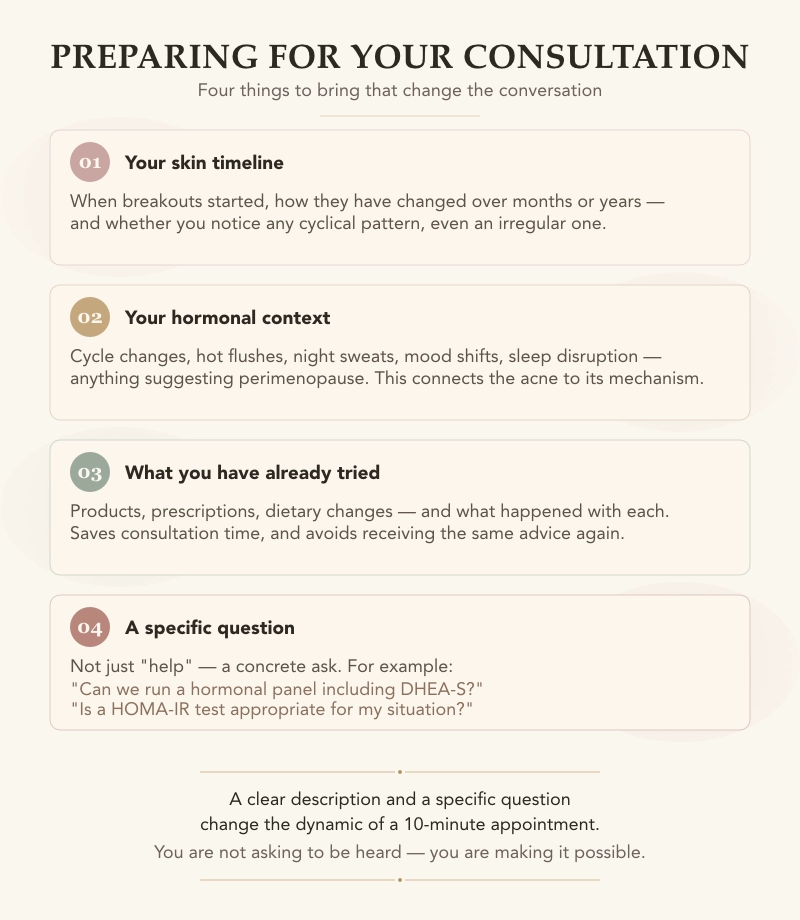
Building a language for the clinical conversation. Arriving at a dermatological or gynecological consultation having read the relevant evidence, prepared to describe not only the acne but its hormonal context (cycle irregularity, vasomotor symptoms, timing of onset relative to perimenopausal changes), and prepared to ask for a hormonal evaluation rather than a topical prescription — this changes the clinical dynamic. The patient who presents with a clear description of her condition and a specific question is more likely to receive a substantive response, according to communication research on consultation outcomes, though large randomised trials in this specific context are not yet available. This is not about adversarial preparedness — it is about making the most of limited consultation time, for both patient and clinician.
Community. The absence of cultural representation for menopausal acne does not mean the community does not exist. It exists in considerable numbers in online spaces — Reddit’s r/Perimenopause and r/Menopause communities contain long, detailed, thoughtful conversations about exactly this experience, predominantly by women who have found that the standard clinical pathway did not provide all the answers and who have built, collectively, a body of peer experience. What distinguishes these spaces is not merely shared complaint — it is the precision of the shared vocabulary: women who have already mapped the hormonal-cycle timing of their breakouts, trialled specific approaches, and documented the outcomes in ways the ten-minute appointment rarely allows for. This is not a substitute for medical care. It is, for many women, the first place they have encountered the recognition that what they are experiencing is shared.
Separating the condition from the meaning. One element of cognitive reframing that the psychodermatological literature supports is the explicit separation of the skin condition from the identity conclusions drawn from it. Acne is a skin condition with a hormonal and metabolic mechanism — one that belongs to the biology of the Menopause, not to any personal failure of discipline or self-care. Because the mechanism is hormonal, it is also time-situated: the inflammatory and sebaceous dynamics of perimenopause do not persist unchanged indefinitely. Understanding that context does not make the acne less frustrating or the psychological burden less real. But it creates a small degree of distance between the condition and the self that experiences it — between what is happening to the skin and what it means about the person. That distance is where therapeutic work becomes possible. It is a practice, not a platitude — and like most practices, it becomes more available with repetition.
When professional psychological support is appropriate. For women whose acne is producing significant depression, social withdrawal, or anxiety that is affecting daily function, referral to a psychologist or psychiatrist with experience in psychodermatology is appropriate care — not a secondary option or a concession that the skin problem cannot be solved.

Researched and written for MEHAUTIQ by Dorota Weiss
Cosmetic formulator trained at Formula Botanica (Advanced Diploma in Organic Cosmetic Science), with an academic research background. Every article is built on peer-reviewed studies read at source, and says plainly where the evidence ends.
Literature
- Amuzescu A et al. Adult Female Acne: Recent Advances in Pathophysiology and Therapeutic Approaches. Cosmetics. 2024;11(3):74. DOI: 10.3390/cosmetics11030074.
- Barbieri JS et al. Patient Perspectives on the Lived Experience of Acne and Its Treatment Among Adult Women With Acne: A Qualitative Study. JAMA Dermatology. 2021;157(9):1040–1046. DOI: 10.1001/jamadermatol.2021.2185.
- Chiu A, Chon SY, Kimball AB. The response of skin disease to stress: changes in the severity of acne vulgaris as affected by examination stress. Archives of Dermatology. 2003;139(7):897–900. doi:10.1001/archderm.139.7.897
- Jović A et al. The Impact of Psychological Stress on Acne. Acta Dermatovenerologica Croatica. 2017;25(2):1133–141. PMID: 28871928
- Tunca M, Balik ZB, Uncu HB, Botsali A. Stigmatization and Psychosocial Burden in Acne Patients. Journal of Cosmetic Dermatology. 2025;24(2):e16678. DOI: 10.1111/jocd.16678.
- Morshed ASM et al. Understanding the impact of acne vulgaris and associated psychological distress on self-esteem and quality of life. Scientific Reports. 2023;13:21084. DOI: 10.1038/s41598-023-48182-6.
- Dias da Rocha MA et al. Unveiling the Nuances of Adult Female Acne. International Journal of Women’s Health. 2024;16:663–678. DOI: 10.2147/IJWH.S431523.
- Tan J et al. Evaluation of Psychological Wellbeing and Social Impact of Combined Facial and Truncal Acne: a Multi-national, Mixed-Methods Study. Dermatol Ther (Heidelb). 2022;12(8):1847–1858. doi:10.1007/s13555-022-00768-0.
- Tanghetti E et al. Understanding the burden of adult female acne. Journal of Clinical and Aesthetic Dermatology. 2014;7(2):22–30. https://pmc.ncbi.nlm.nih.gov/articles/PMC3935648/
- Parkinson H. Adult and perimenopausal acne and the nurse’s role in management. British Journal of Nursing. 2026;35(3). DOI: 10.12968/bjon.2025.0559.
- Perkins AC et al. Acne vulgaris in women: prevalence across the life span. Journal of Women’s Health (Larchmt). 2012;21(2):223–230. doi:10.1089/jwh.2010.2722
- Poli F, Dreno B, Verschoore M. An epidemiological study of acne in female adults: results of a survey conducted in France. Journal of the European Academy of Dermatology and Venereology. 2001;15(6):541–545. doi:10.1046/j.1468-3083.2001.00357.x
- Zouboulis CC. Et al., Corticotropin-releasing hormone: An autocrine hormone that promotes lipogenesis in human sebocytes., Proc. Natl. Acad. Sci. U.S.A. 2002 99:10 7148-7153, https://doi.org/10.1073/pnas.102180999