What Actually Happened on Menopausal Skin in Winter
Part 4 of the Barrier Repair Series — the eight-week results, the ceramide concentration question answered, and what long-term structural repair actually looks like in menopausal skin.
The Experiment in Brief (For When You Are Skimming Between Meetings)
- Eight weeks of consistent ceramide application produced visible, structural improvement on perimenopausal skin — confirmed by photographic comparison under controlled conditions.
- The hand, which started in worse condition, showed the largest gains. Comfort arrived first; visible repair followed weeks later.
- Delivery architecture partially compensated for below-threshold ceramide concentration — but concentration still matters for speed of repair.
- Single-participant data has real limitations. The principles are generalisable; the specific numbers are not. Your eight weeks may look different.
In this article
- Two Sets of Photographs, Eight Weeks Apart
- The Complete Eight-Week Data
- Reading the Trajectory: A Story in Three Acts
- What the Research Predicted — and What Happened
- The Ceramide Concentration Question
- What Worked Better Than Expected
- What Remained Ambiguous
- What This Suggests for Your Approach
- An Eight-Week Answer to a December Question
Two Sets of Photographs, Eight Weeks Apart
If you are a woman in perimenopause or menopause — somewhere between 40 and 55, watching your skin behave in ways it never used to — this article is for you. Not for a general audience. For you, specifically, because the biology of your skin right now is different from what most skincare content assumes.
I have been staring at two sets of photographs for several days. One from early December, one from early February. I know what I want to see in them. I also know that wanting something to be true is precisely the condition that makes objective observation unreliable.
So let me describe what is visible before interpreting it.
The hand: the deep transverse cracks are no longer present as open structures. The area that showed the most acute compromise — raised, rough, with visible flaking — now shows a smooth surface with normal skin texture.
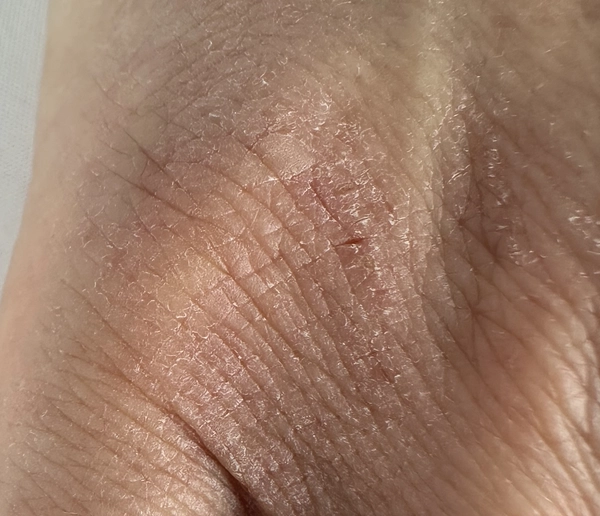
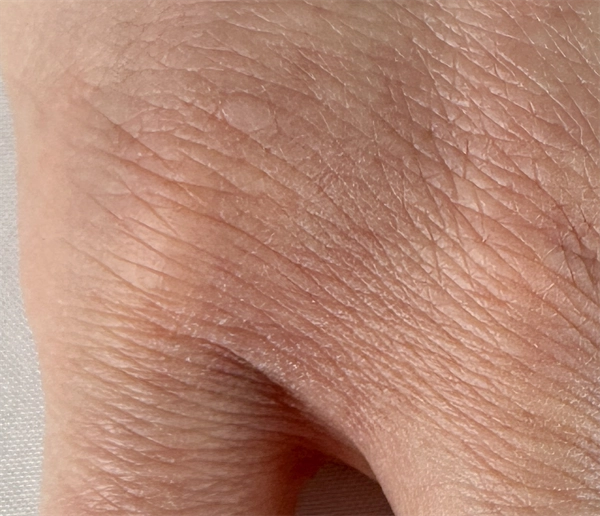
The shin: the extensive white scaling visible in December, particularly obvious against dark fabric, is largely gone. Some fine texture variation remains, but its character has changed from dry and chalky to something that looks and feels normal.
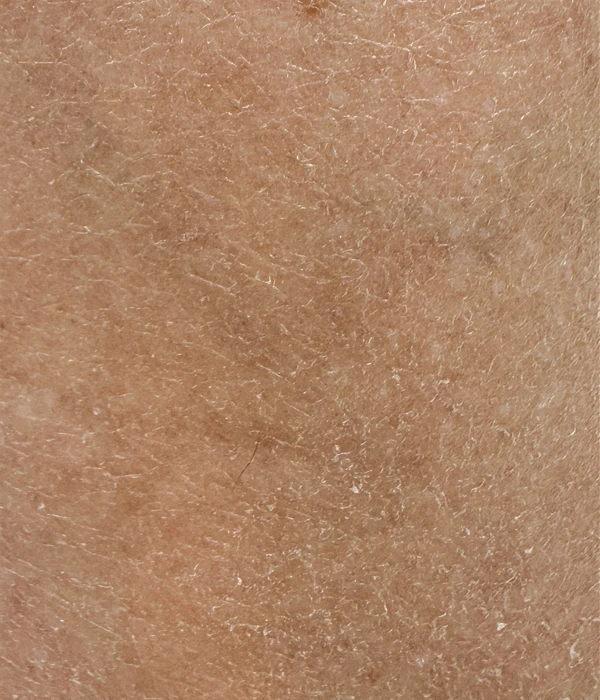
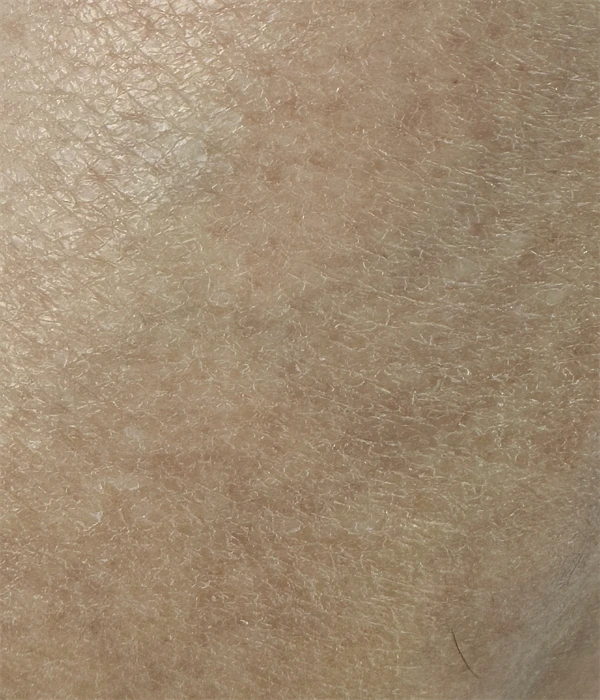
These are real changes. I’m confident enough in the photographic protocol — same area of the body, same angle, same time of day — to say that. And if you have spent recent winters noticing your skin no longer recovers the way it did before perimenopause, these results carry a specific kind of weight.
The Complete Eight-Week Data
Three assessment methods tracked the shin weekly. Before the numbers: a VAS roughness score of 65 mm is the skin that catches on your tights. A score of zero is the skin that doesn’t. These measurements translate directly to sensations you know — the tightness after a shower, the flaking onto dark clothes.
Quick read: Comfort improved dramatically in week one and held. Visible repair reached its best at week six. Week seven brought a temporary setback from temperature swings; by week eight the skin had bounced back. Overall: 83–100% reduction across every symptom measured.
Table 1: VAS Assessment — Shin (Weeks 0–8)
| Shin (Left) | Dryness & Flaking (mm) | Roughness (mm) | Tightness & Discomfort (mm) | Overall Skin Condition (mm) |
|---|---|---|---|---|
| Week 0 (baseline) | 40 | 65 | 56 | 47 |
| Week 1 | 0.1 | 20 | 12 | 0.7 |
| Week 2 | 9 | 4 | 0 | 7 |
| Week 3 | 8 | 2.5 | 2 | 3.5 |
| Week 4 | 2 | 0 | 0 | 0 |
| Week 5 | 6 | 0 | 0 | 1 |
| Week 6 | 0 | 0 | 0 | 0 |
| Week 7 | 1 | 10 | 3.5 | 12 |
| Week 8 | 7 | 0 | 0 | 1 |
VAS: 0 mm = no symptoms; 100 mm = most severe. Lower scores indicate improvement.
These numbers capture how the skin felt — the sensations that greet you every morning. The baseline roughness of 65 mm is where this experiment began.
Table 2: SRRC Clinical Grading — Shin (Weeks 0–8)
| Shin (Left) | Scaling (0–4) | Roughness (0–4) | Redness (0–4) | Cracks / Fissures (0–4) | SRRC Total (/16) |
|---|---|---|---|---|---|
| Week 0 (baseline) | 2 | 1 | 0 | 2 | 5 |
| Week 1 | 1 | 1 | 0 | 0 | 2 |
| Week 2 | 1 | 0 | 0 | 0 | 1 |
| Week 3 | 1 | 0 | 0 | 0 | 1 |
| Week 4 | 0 | 0 | 0 | 0 | 0 |
| Week 5 | 0 | 1 | 0 | 0 | 1 |
| Week 6 | 0 | 0 | 0 | 0 | 0 |
| Week 7 | 0 | 0 | 0 | 0 | 0 |
| Week 8 | 1 | 0 | 0 | 0 | 1 |
SRRC: Each parameter scored 0–4 (0 = absent, 4 = severe). Total score out of 16. Lower scores indicate improvement.
If VAS captures what you feel, SRRC captures what a clinician would see. For menopausal skin, where sensation and appearance often tell different stories, both measures matter.
Reading the Trajectory: A Story in Three Acts
Think of barrier repair like renovating a house you’ve lived in for decades. Act one is patching the leaks — fast, noticeable, a relief. Act two is the slower structural work behind the walls. Act three is the first real storm, when you find out whether the repairs hold.
Act One (Weeks 1–3): Every parameter plunged from baseline — dryness from 40 mm to single digits, roughness from 65 to under 5, tightness from 56 to near zero. For perimenopausal and menopausal skin, where declining estrogen has already thinned the lipid barrier, this rapid comfort response tells you the product is reaching the right layer.
Act Two (Weeks 4–6): Scores settled near zero. By week six, all four parameters hit zero simultaneously. This is the quiet phase — the one where many women in midlife give up on a product because they can’t see continued change. But structural reorganisation of the lipid barrier was ongoing beneath the surface.
Act Three (Weeks 7–8): The durability test. Despite slightly warmer temperatures (−7 to −1°C), roughness at week seven jumped to 10 mm and overall condition spiked to 12 mm. Then at week eight, roughness dropped to zero and overall returned to 1 mm.
“I expected the cold weeks to be the worst,” I wrote in my notebook. “But it’s the thaw-and-freeze days that really set my skin off.” That observation aligns precisely with the data. Temperature fluctuation — not pure cold — appears to be the trigger. The important finding: the setback was transient. The barrier was resilient enough to bounce back, confirming genuine repair rather than surface-level patching.
Table 3: Baseline vs. Week 8 — The Distance Travelled
| Measure | Baseline | Week 8 | Change |
|---|---|---|---|
| VAS Dryness (mm) | 40 | 7 | – 83% |
| VAS Roughness (mm) | 65 | 0 | – 100% |
| VAS Tightness (mm) | 56 | 0 | – 100% |
| VAS Overall (mm) | 47 | 1 | – 98% |
| SRRC Total | 5 / 16 | 1 / 16 | – 80% |
Negative values indicate improvement.
The hand, which started in significantly worse condition, showed the largest total improvement. Deep cracks resolved, flaking ceased, and the skin showed normal texture by week eight. Comfort arrived first and held; visible dryness followed a more uneven path.
What the Research Predicted — and What Happened
| Outcome | Prediction | What Happened |
|---|---|---|
| All-day comfort | From multi-level hydration | Achieved week 1. Held from week 2 |
| Reduced reactivity | Within 4 weeks | Resolved week 1. Did not return under cold stress. |
| Smoother texture | Weeks 6–8 | Visible from week 6. Pronounced by week 8. |
| Stress resilience | Uncertain | Partial. Comfort held; texture regressed at weeks 3, 5, 7 but recovered. |
| Below-min ceramide | Unknown | Improvement occurred. Delivery compensated partially. Slower than benchmarks. |
The Ceramide Concentration Question
The formula contained approximately 0.1–0.15% actual ceramides — below the 0.2–2% range that clinical literature identifies as meaningful for barrier repair. Would lamellar delivery architecture compensate?
The data suggests: partially, and possibly sufficiently for moderate barrier compromise. The improvement is real but the rate was slower than published benchmarks — consistent with Coderch et al.’s findings in American Journal of Clinical Dermatology (2003) that concentration and delivery are both independent contributors to barrier outcomes.
The practical analogy: think of it as the difference between scattering seeds across a field and planting them in prepared rows. Lamellar structure organises ceramides in layered sheets that mirror your skin’s own lipid arrangement. For menopausal skin, where the lipid bilayer has thinned due to hormonal shifts, this organised delivery may matter even more than for younger skin. But quantity is not irrelevant. For severe compromise or faster results, higher concentration with equivalent delivery would likely perform better.
When reading labels, look for both ceramide concentration and lamellar delivery claims. A lower-concentration product with sophisticated delivery may outperform a higher-concentration product in a basic base — but a product offering both is your best starting point.
What Worked Better Than Expected
The speed of the comfort response. The hypothesis predicted improvements within four weeks; they arrived within one. If you have felt the relief of a product that seems to work immediately, you understand why this matters — it is the difference between trusting a process and abandoning it.
The resilience of those gains. Once itching and tightness resolved, they did not return — even during visible regression. It is like a house where the heating works perfectly even though the exterior paint is still being finished. The underlying repair was further along than the mirror suggested.
What Remained Ambiguous
The hand’s mid-study regression was real and visible. I felt frustrated by it — the kind of frustration you may recognise if you have watched your skin undo a week’s progress overnight in cold weather. A higher ceramide concentration or twice-daily application might have maintained gains more consistently.
The post-study question remains open. By the time tracking ended and temperatures rose, the hand had returned to excellent condition — but I cannot say whether that represents the formula’s full effect or warmer weather completing what the formula began.
What This Suggests for Your Approach
Give your skincare product twelve weeks if you can. The most interesting structural changes may still be developing at eight, particularly for women in perimenopause or menopause where cell turnover has slowed.
In winter, twice-daily application is likely worth it. Under sustained cold and low humidity, a second morning application would maintain visible gains more effectively — especially for menopausal skin, where the compromised lipid barrier loses moisture faster than it did a decade ago.
Remember: single-participant data has real limitations. Everything here reflects one person’s skin. The principles are generalisable. The specific numbers are not. Your eight weeks may look different, and that does not make either result wrong.
An Eight-Week Answer to a December Question
We began in December asking what evidence-driven barrier repair looks like when you actually do it — not in a trial, not in an advertisement, but on real menopausal skin in real winter. The answer is slower, more variable, and more context-dependent than any label suggests. But it is also real.
The photographs from February show skin that is structurally different from December. That difference accumulated over eight weeks and held through a demanding winter. The question was whether the biology of barrier repair — on skin changed by hormonal shifts, on skin that no longer forgives neglect the way it once did — is visible, trackable, and honest.
It is.
The flakes on the black trousers are gone.
More From This Series
This experiment has four parts. The formula and its ingredients are introduced in Creating a Barrier Repair Formula: My 8-Week Experiment. Weeks one through three are documented in The First Three Weeks of Ceramide Barrier Repair. The mid-point results appear in Skin Barrier Repair at Week 6: What Real Progress Looks Like in Midlife Skin.

Researched and written for MEHAUTIQ by Dorota Weiss
Cosmetic formulator trained at Formula Botanica (Advanced Diploma in Organic Cosmetic Science), with an academic research background. Every article is built on peer-reviewed studies read at source, and says plainly where the evidence ends.
Literature:
Coderch L, López O, de la Maza A, Parra JL. Ceramides and skin function. Am J Clin Dermatol. 2003;4(2):107-29. doi: 10.2165/00128071-200304020-00004.