Understanding ingredient labels is only the beginning. Even the most sophisticated products fail when layered in the wrong order or used without a foundation. Here’s how to build a routine that respects your skin’s changing biology.
You own a retinol serum, a vitamin C treatment, and a ceramide moisturizer. You’ve read the labels. You understand why your skin needs physiologic lipids and humectants. Yet your skin still feels tight by afternoon, and that expensive peptide treatment seems to do nothing.
The problem isn’t your products. It’s the architecture.
During menopause, your skin undergoes fundamental structural changes. A 2022 study by Kendall and colleagues found that declining estrogen disrupts ceramide production at the molecular level — your skin doesn’t just make fewer ceramides, it makes shorter ones. These abbreviated lipid chains create gaps in your barrier, like mortar that crumbles between bricks. Water escapes. Irritants enter. Products that once worked suddenly sting.
But this isn’t damage. It’s adaptation to new hormonal conditions. And with the right framework, you can work with these changes rather than against them.
Key Takeaways (For When You Are Skimming Between Meetings)
- Not all ingredients serve the same function. Protection comes before transformation. Sunscreen, antioxidants, and barrier – supporting lipids are the foundation; retinoids and hydroxy acids are the next tier; peptides and growth factors are optional.
- Menopause shortens ceramides, weakening your barrier. Topical ceramides, cholesterol, and fatty acids can physically repair the lipid matrix — but only if applied in the right sequence.
- Layer products from thinnest to thickest. Water-based serums penetrate first; oil-based occlusives seal last. Reverse this, and your products cannot reach their target layers.
- Timing matters. Apply protective ingredients (antioxidants, SPF) in the morning when skin is in defense mode; apply reparative actives (retinoids) at night when permeability and repair mechanisms peak.
- Low-molecular-weight hyaluronic acid penetrates; high-molecular-weight HA forms a surface film. Look for multi-weight formulas to hydrate at multiple depths.
- If products sting, your barrier is compromised. Stop actives and revert to basics (cleanser, lipid-rich moisturizer, SPF) for two to four weeks. If sensitivity persists beyond ten days, see a dermatologist.
- Retinoids require gradual introduction. Start with 0.25% to 0.5% retinol once or twice weekly on dry skin. Increase frequency slowly over four to six weeks as tolerance builds.
In this article
- The Hierarchy Your Skin Actually Needs
- How to Layer: The Physics of Penetration
- Timing: When Your Skin Is Most Receptive
- Building Your Own System
The Hierarchy Your Skin Actually Needs
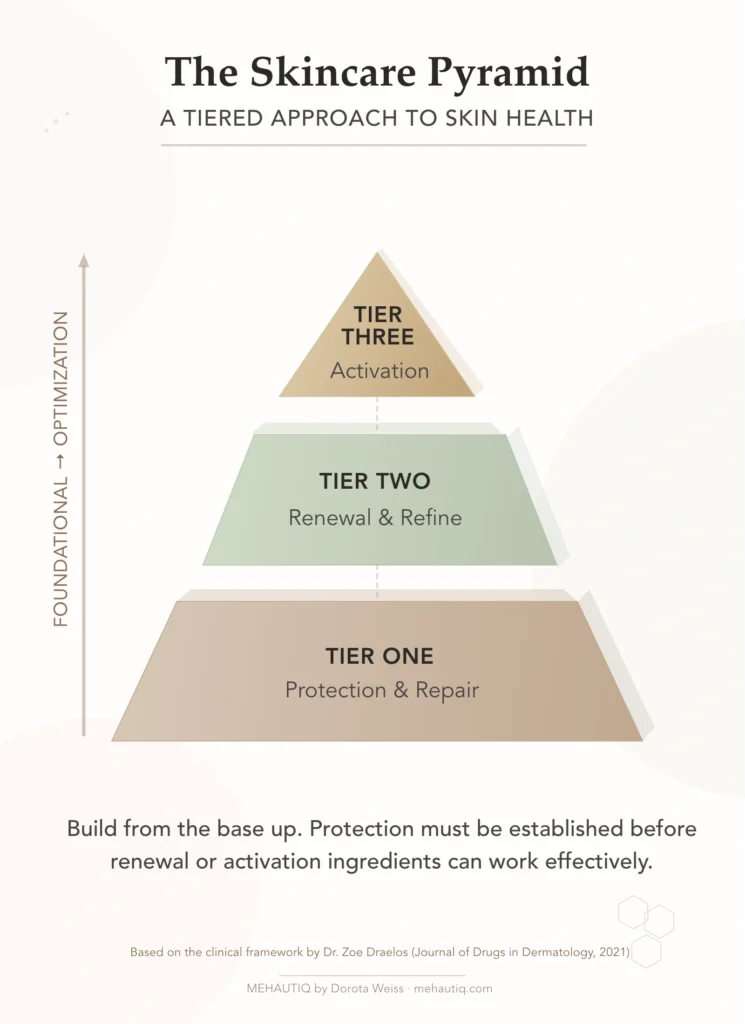
Not all ingredients serve the same purpose, and attempting to use transformative actives before establishing basic protection is like installing marble countertops in a house with a leaking roof. The work is wasted.
Dr. Zoe Draelos, a board-certified dermatologist and researcher, developed a clinical framework that organizes skincare ingredients into three functional tiers: Protection, Renewal, and Activation. Each tier builds on the one below it. Skip the foundation, and everything above becomes ineffective — or worse, irritating.
Think of it as Maslow’s hierarchy, but for your face. You cannot optimize cellular communication if your barrier is compromised. You cannot address pigmentation if your skin is being oxidized by UV radiation faster than any serum can correct it.
Everything covered in this article — the layering sequence, the morning-evening logic, the barrier reset protocol — is distilled into a single reference sheet you can keep by your bathroom mirror. Download it at the end of this article.
Tier One: Protection and Repair
This tier addresses survival – level needs: shielding skin from external damage and supporting its inherent repair mechanisms. Without this foundation, every other investment is undermined.
Why Sun Protection Becomes More Important During Menopause
Broad-spectrum sunscreen (SPF 30 or higher) is the single most consequential product in any routine. UV radiation — both UVA and UVB — accounts for approximately 80% of visible facial aging. But the protection needs to extend beyond UV. Modern formulations should ideally include mineral filters like zinc oxide or titanium dioxide, which also block visible light. Why does this matter? Visible light generates oxidative stress that triggers inflammation and can worsen pigmentation — an especially relevant concern during menopause when skin becomes more reactive.
For women in perimenopause and menopause, the case for daily sunscreen becomes even more urgent. Estrogen normally supports your skin’s antioxidant defense system. As estrogen declines, your skin’s ability to neutralize free radicals diminishes. UV exposure that your skin once tolerated now causes disproportionate oxidative damage.
How antioxidants compensate for the lack of estrogen
Antioxidants function as your backup defense system. Vitamin C, vitamin E, and other antioxidants neutralize free radicals generated by UV exposure, infrared radiation, and environmental pollutants— oxidative stressors your sunscreen cannot fully block. Menopausal skin, with its reduced endogenous antioxidant capacity, needs this external support more than younger skin does.
A practical note: Vitamin C is notoriously unstable. Look for formulations in opaque, airtight packaging. L-ascorbic acid (the most researched form) requires a pH below 3.5 to remain stable and penetrate effectively — which is why many vitamin C serums feel slightly acidic on application.
DNA repair enzymes: A new generation in skin protection
DNA repair enzymes represent a newer category of protective ingredients. Enzymes like photolyase and T4 endonuclease V identify and repair thymine dimers — the “kinks” in DNA strands caused by UV exposure. These enzymes work overnight to prevent UV-induced mutations from becoming permanent. The clinical evidence here is still emerging, but early research suggests they offer meaningful photoprotection when used consistently. They are not essential in the way sunscreen is, but for someone concerned about cumulative sun damage, they may be worth considering.
Why Your Skin Barrier Breaks Down Without Ceramides
Barrier-supporting ingredients — hyaluronic acid, niacinamide, and ceramides — maintain hydration and structural integrity. These are not optional enhancements; they are structural necessities. Hyaluronic acid (in its various molecular weights) attracts and holds water in the epidermis. Niacinamide strengthens the barrier, reduces transepidermal water loss, and modulates inflammation. Ceramides, along with cholesterol and fatty acids, form the lipid matrix that literally holds your barrier together.
Tier Two: Renewal
Once protection is in place, you can focus on transformation—ingredients that accelerate cellular turnover, rebuild structural proteins, and improve barrier function.
Why Retinoids Remain the Gold Standard
Retinoids are the most extensively studied anti-aging ingredient in dermatology. Retinol, tretinoin, and retinaldehyde all work by binding to retinoic acid receptors in skin cells, stimulating collagen synthesis, thickening the epidermis, and normalizing cell turnover. For menopausal skin, retinoids partially compensate for the loss of estrogen – driven collagen production.
But retinoids require strategic introduction. Start with a low concentration (0.25% to 0.5% retinol) applied once or twice weekly. Gradually increase frequency over four to six weeks as your skin adapts. Apply a pea-sized amount to dry skin — never damp, as water increases penetration and therefore irritation. If you experience persistent redness, peeling, or sensitivity, reduce frequency. Retinoids work through consistent, low-level stimulation, not aggressive application.
How Hydroxy Acids Renew Dull Skin
Hydroxy acids — alpha hydroxy acids (AHAs) like glycolic and lactic acid, and beta hydroxy acids (BHAs) like salicylic acid — dissolve the bonds (desmosomes) that hold dead cells together. As estrogen declines, cellular turnover slows, leading to a buildup of dead cells on the skin’s surface. This manifests as dullness, rough texture, and uneven tone. Hydroxy acids accelerate desquamation, revealing fresher skin beneath.
AHAs are water-soluble and work on the skin’s surface, making them effective for texture and tone. BHAs are lipid-soluble, meaning they penetrate into pores — useful if you experience hormonal breakouts. For most menopausal skin, a once – or twice – weekly AHA treatment (8% to 10% glycolic or lactic acid) provides noticeable improvement without over – exfoliation.
Tier Three: Activation
This tier includes peptides, growth factors, and stem cell–derived ingredients — actives that aim to stimulate cellular signaling and regeneration at a deeper level. Peptides are short chains of amino acids that, in theory, instruct fibroblasts to produce more collagen. Growth factors attempt to replicate the signaling molecules that drive tissue repair.
The clinical evidence for this tier is mixed. Some peptides have demonstrated modest improvements in fine lines and firmness in controlled studies, but the results are generally subtler than those achieved with retinoids or consistent sun protection. If your budget is limited, prioritize Tiers One and Two first. A peptide serum cannot compensate for daily UV exposure or a compromised barrier.
That said, for someone who has mastered the foundation and is looking for optimization, these ingredients may provide incremental benefits. Just manage expectations.
How to Layer: The Physics of Penetration
Owning the right ingredients is only half the equation. The order in which you apply them determines whether they can actually reach their target layers in the skin.
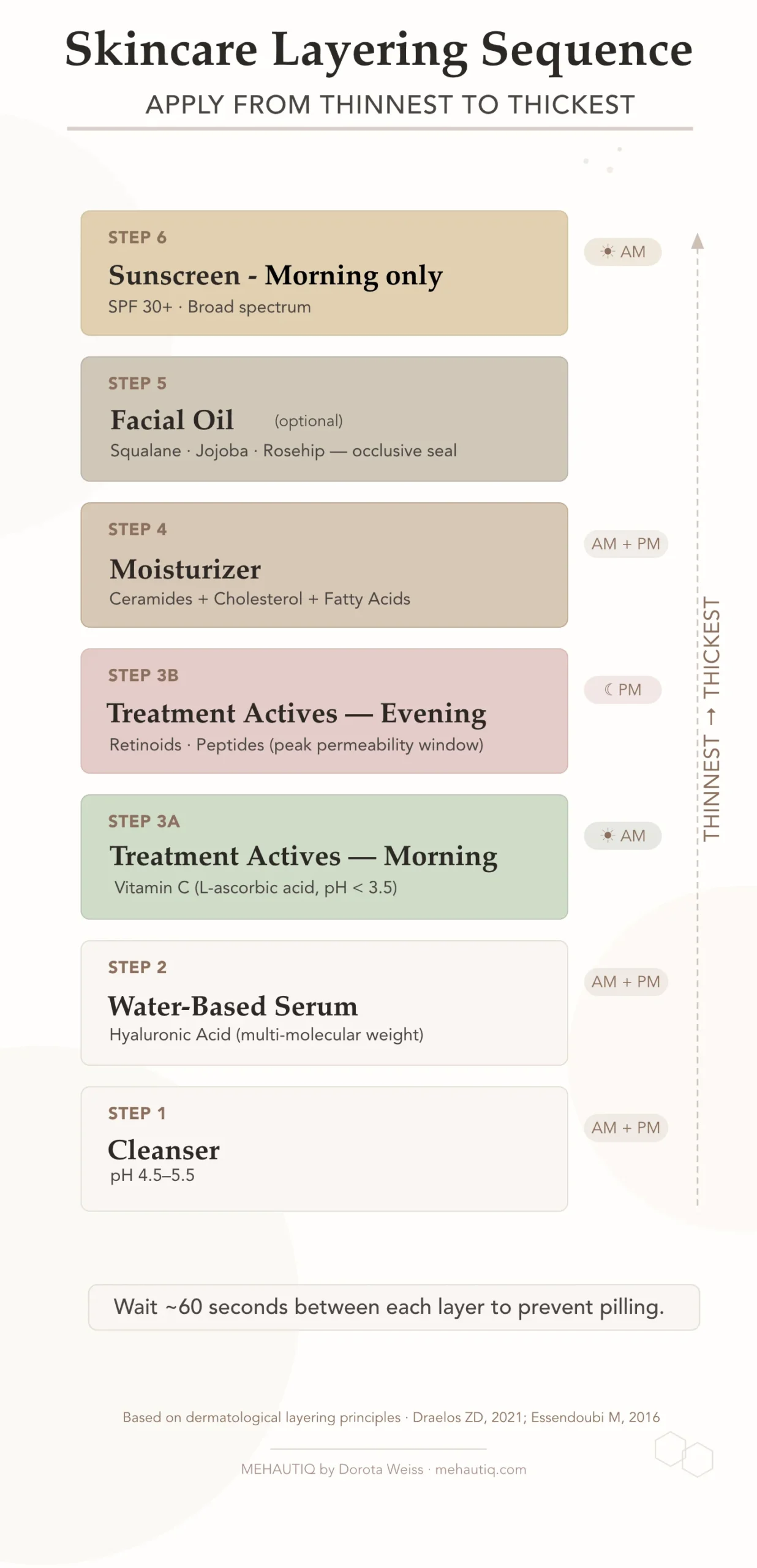
The fundamental principle is thinnest to thickest. This respects both molecular size and formulation viscosity. Water-based serums penetrate first. Oil-based occlusives seal last. Reverse this order, and your hydrating serum sits uselessly on top of your facial oil.
Step One: Cleanse
Barrier repair begins before you apply anything else. Use a pH-balanced cleanser with a pH between 4.5 and 5.5. Your skin’s acid mantle — a protective film of sebum and sweat — has a natural pH around 4.7. Alkaline cleansers (traditional bar soaps often have a pH of 9 to 10) strip this mantle, disrupt the microbiome, and leave your barrier vulnerable for the next four to six hours.
If your skin feels “squeaky clean” after washing, you’ve just compromised your barrier. Clean skin should feel soft, not stripped.
If you wear makeup or sunscreen, double cleanse: an oil-based cleanser first to dissolve makeup and sebum, followed by a water-based cleanser to remove water-soluble impurities.
Step Two: Water-Based Serums
This is where hydration begins. Hyaluronic acid serums, essence-type products, and lightweight hydrators go here.
But not all hyaluronic acid works the same way. A 2016 study by Essendoubi demonstrated that only low-molecular-weight hyaluronic acid (20 to 300 kilodaltons) can penetrate the stratum corneum. High-molecular-weight hyaluronic acid (above 1,000 kDa) remains on the surface, forming a protective film.
The solution: use a multi-molecular-weight serum. The small molecules hydrate deeper layers; the large molecules create a surface barrier that reduces transepidermal water loss.
Application tip: apply hyaluronic acid to damp — not soaking wet — skin. Hyaluronic acid is a humectant, meaning it binds to water. If applied to completely dry skin in a low-humidity environment, it can paradoxically draw moisture out of deeper layers. A few drops of water or a damp face gives it something to bind to.
Step Three: Treatment Actives
Apply targeted treatments here — vitamin C serum in the morning, retinoid at night, peptide serums if you’re using them. Placing these after your hydrating step ensures they are close enough to the skin to work, but slightly buffered by the hydration layer, which can reduce irritation.
Step Four: Moisturizer
For menopausal skin, this step is non negotiable. You need a formula that contains physiologic lipids: ceramides, cholesterol, and fatty acids. These lipids don’t just sit on the surface, they integrate into your skin’s lipid matrix, physically filling the gaps left by shortened ceramides.
Avoid moisturizers that rely solely on humectants (like glycerin) or emollients (like dimethicone) without these structural lipids. They may feel pleasant in the short term, but they don’t repair the underlying architecture.
Step Five: Facial Oil (Optional)
If your skin feels dry even after moisturizer, add a facial oil as your final step. Oils function as occlusives, they create a seal that prevents water loss.
The order matters. Apply oil after moisturizer, not before. Oil forms a hydrophobic barrier. If you apply it first, your water-based moisturizer cannot penetrate through it. It’s the equivalent of wearing a raincoat in the shower.
Best options for menopausal skin: squalane (which mimics your skin’s natural sebum), jojoba oil, or rosehip oil.
Step Six: Sunscreen (Morning Only)
Sunscreen is always your final step in the morning. It must form an even, uninterrupted film on the skin’s surface to be effective. Applying anything on top (except makeup) disrupts this film and reduces protection.
Timing: When Your Skin Is Most Receptive
Skin doesn’t function the same way at all hours. Research in chronobiology, the study of biological rhythms, shows that skin follows a predictable 24-hour cycle. Protection peaks during the day; repair peaks at night.
Morning: Defend
Sebum production is higher in the morning. Skin pH is slightly elevated. Permeability is lower. Your skin is in defense mode.
Your routine should reflect this: lightweight hydration, antioxidants, and sunscreen. For women experiencing hot flashes, heavy layering in the morning can feel suffocating. A simple sequence: cleanser, multi-weight hyaluronic acid serum, lightweight ceramide moisturizer, SPF, is often sufficient.
Evening: Restore
At night, your skin becomes more permeable. Transepidermal water loss peaks between evening and overnight. This heightened permeability creates both an opportunity and a risk.
The opportunity: absorption is at its highest, making this the optimal time for active ingredients like retinoids.
The risk: you lose more water. This is why night creams are typically richer and more occlusive. You need that extra sealing layer to compensate for increased water loss during repair mode.
Troubleshooting: When the System Breaks Down
Even with the right products and proper layering, execution errors can derail results.
Pilling
You apply your serum, and it rolls off in little white balls. This is called pilling, and it’s usually caused by incompatible formulations or insufficient drying time between layers. A 2024 study identified sunscreen as the most common culprit, accounting for roughly 80% of pilling events due to friction.
The fix: wait 60 seconds between each layer. Apply products with a gentle patting motion rather than rubbing. If you wear foundation, applying it over sunscreen often locks the layer in place and resolves the issue.
No Visible Results
If you’ve been using a routine consistently for six to eight weeks without improvement, check the ingredient list of your moisturizer. Does it contain ceramides and cholesterol and fatty acids? Many products contain ceramides alone, but without cholesterol to structure the lipid bilayers, the barrier cannot properly reform. It’s like having bricks without mortar.
Stinging or Sensitivity
If products sting immediately upon application, your barrier is compromised. Stinging is not “purging” or “working” — it’s a signal that your barrier cannot tolerate what you’re applying.
The solution: stop all actives (retinoids, acids, vitamin C) and revert to the basics for two to four weeks. Use only a gentle cleanser, a lipid-rich moisturizer, and sunscreen. Once the stinging stops, reintroduce actives slowly, one at a time, starting at the lowest frequency.
If sensitivity doesn’t improve within seven to ten days, or if it worsens, you may be dealing with contact dermatitis (allergic or irritant), rosacea, eczema, or a product allergy. At that point, professional evaluation is necessary. Dr. Sandy Skotnicki, a leading expert in contact dermatitis, emphasizes that damaged barriers should improve with proper care within two weeks. If they don’t, schedule a dermatology appointment.
Building Your Own System
The framework above is not prescriptive. It’s not a mandate to buy ten products. It’s a diagnostic tool.
Start by identifying what you already have. Categorize each product into Tier One, Two, or Three. Do you have protection covered? If not, that’s your starting point. Once you have consistent sun protection and barrier support in place for four to six weeks, then consider adding a renewal-tier active like a retinoid or hydroxy acid.
This is not about perfection. It’s about priority. Some nights you’ll be too tired for a five-step routine. On those nights, cleanser, moisturizer, and done is enough. The system exists to guide decisions, not to create guilt.
Your skin isn’t broken. It’s operating under new rules, rules shaped by hormonal changes that are entirely normal. The challenge isn’t to reverse menopause. It’s to understand your skin’s current needs and meet them strategically.
When you do that, products stop failing. Not because they’ve changed, but because you’re finally using them in a way your skin can actually respond to.
FREE DOWNLOAD
The morning-evening routine from this article, condensed into PDF. Layering order, timing, the barrier reset protocol — ready to use.
Free · No login required

Researched and written for MEHAUTIQ by Dorota Weiss
Cosmetic formulator trained at Formula Botanica (Advanced Diploma in Organic Cosmetic Science), with an academic research background. Every article is built on peer-reviewed studies read at source, and says plainly where the evidence ends.
Literature
The references for this guide were chosen based on peer-reviewed status.
Peer-Reviewed Scientific Literature
- Kendall AC, et al. Menopause induces changes to the stratum corneum ceramide profile that are prevented by hormone replacement therapy. Scientific Reports, 2022; 12:21715.
- Draelos ZD. Revisiting the Skin Health and Beauty Pyramid: A Clinically Based Guide to Selecting Topical Skincare Products. J Drugs Dermatol. 2021 Jun 1;20(6):695-699. doi: 10.36849/JDD.2021.5883.
- Essendoubi M, Gobinet C, Reynaud R, Angiboust JF, Manfait M, Piot O. Human skin penetration of hyaluronic acid of different molecular weights as probed by Raman spectroscopy. Skin Res Technol. 2016 Feb;22(1):55-62. doi: 10.1111/srt.12228.
- Yosipovitch G, Xiong GL, Haus E, Sackett-Lundeen L, Ashkenazi I, Maibach HI. Time-dependent variations of the skin barrier function in humans: transepidermal water loss, stratum corneum hydration, skin surface pH, and skin temperature. J Invest Dermatol. 1998 Jan;110(1):20-3. doi: 10.1046/j.1523-1747.1998.00069.x.
- Draelos ZD. New treatments for restoring impaired epidermal barrier permeability: skin barrier repair creams. Clin Dermatol. 2012 May-Jun;30(3):345-8. doi: 10.1016/j.clindermatol.2011.08.018.
- Del Rosso JQ, Kircik L. Skin 101: Understanding the Fundamentals of Skin Barrier Physiology-Why is This Important for Clinicians? J Clin Aesthet Dermatol. 2025 Feb;18(2):7-15. PMID: 40078856;
- Messaraa C, Robertson N, Walsh M, Hurley S, Doyle L, Mansfield A, Daly L, Tansey C, Mavon A. Clinical evidences of benefits from an advanced skin care routine in comparison with a simple routine. J Cosmet Dermatol. 2020 Aug;19(8):1993-1999. doi: 10.1111/jocd.13252.
- Giardina S, Poggi A. Skin Penetration Ability of 12 Hyaluronic Acids with Different Molecular Weights After Topical Application. JOJ Dermatol & Cosmet. 2023; 5(3): 555665. DOI: 10.19080/JOJDC.2023.05.555665
Educational Resources (Non-Peer-Reviewed)
- Baumann Skin Type Solutions. How to layer skin care ingredientsBaumann Skin Type Solutions Blog. https://skintypesolutions.com/blogs/skincare/how-to-layer-skin-care-ingredients