You moisturize more than you did in your 30s, yet your cheeks still feel papery by mid-afternoon. A cream that once left your face glowing now seems to vanish without a trace. Standing in the pharmacy aisle, every second jar claims to “repair the barrier” for “mature skin”—but they all sound the same.
If this feels familiar, two things are true at the same time: your skin has genuinely changed at a molecular level, and most product labels were never written with your specific biology in mind.
The outer layer of your skin has restructured itself, particularly in the lipids that keep water in and irritation out. Those changes make barrier-repair ingredients more than marketing language. They become part of how you decide what deserves a place on your bathroom shelf.
This is not about finding the “right product.” It is about understanding the patterns behind the claims, so that when you pick up a jar, you can think, Does this formula even contain the building blocks my skin now needs? rather than Is this the one magical cream I’ve been missing?
Key Takeaways (For When You Are Skimming Between Meetings)
- Menopause restructures the lipid “grout” holding your skin cells together—specific ceramides drop sharply, creating a leakier, drier, more reactive barrier that feels and behaves differently than it did a decade ago.
- The most effective barrier-repair formulas for this life stage combine all three lipid families—ceramides, cholesterol, and fatty acids—not ceramides in isolation, because your barrier needs the complete lipid triangle to rebuild properly.
- Ceramides NP, AP, and EOP decline most steeply during menopause, making products that include these specific types more aligned with what your skin is now missing.
- Multi-weight hyaluronic acid hydrates surface layers and signals deeper skin structures simultaneously; single-weight HA often feels disappointingly thin after 40 because it addresses only one dimension of dryness.
- pH-balanced, low-foam formulas become more important as menopausal skin loses its tolerance for alkaline products, which disrupt enzyme activity, lipid production, and microbial balance.
- Ingredient lists guide probability, not perfection—patterns like complete lipid families, layered HA, barrier-friendly pH, and clinical testing increase the odds that a product will match your skin’s new reality.
In this article
- When the Barrier Starts Behaving Like Badly Mixed Mortar
- The Lipid Triangle: Ceramides, Cholesterol, and Fatty Acids Working Together
- Reading Ingredient Lists Like a Probability Game, Not a Promise
- Hyaluronic Acid Layers: Why “Hydrating” Suddenly Feels Inadequate
- When You Cannot See the Most Important Part of the Formula
- pH Balance: The Quiet Amplifier of Irritation After 40
- Timeframes, Seasons, and Expectation Management
- A Calmer Way to Judge Barrier-Repair Claims
When the Barrier Starts Behaving Like Badly Mixed Mortar
Skin that once bounced back now marks easily, stings faster, and dries out in rooms that never used to bother you. That is not vaguely “getting older”—it is a very specific shift in the outermost layer of skin, the stratum corneum.
Picture this layer as a brick wall made of tightly packed tiles held together by mortar. The “tiles” are your skin cells. The “mortar” is a structured blend of lipids—mainly ceramides, cholesterol, and fatty acids. When the mortar is freshly mixed and properly set, it holds firm and flexible. When the mix is wrong—too little binder, uneven ratios, weak curing—the wall becomes porous and fragile.
That is what happens during menopause. The lipid mortar becomes thinner, uneven, and more permeable. Specifically:
- There are fewer ceramides overall, with sharp losses in ceramides NP, AP, and EOP.
- The ceramides that remain often have shorter molecular chains, which makes the structure more leaky.
- Water escapes more easily, and irritants slip through.
You feel this as tightness after cleansing, recurring redness around the nose and mouth, or a strange combination of dryness and congestion. A friend might say, “Just use a richer moisturizer,” but richness alone does not address mortar that is crumbling at a molecular level.
The Lipid Triangle: Ceramides, Cholesterol, and Fatty Acids Working Together
Most barrier-repair claims revolve around ceramides, but ceramides alone are not the whole story. That mortar mixture is built on a three-sided relationship:
- Ceramides–the structural plates that lock cells together.
- Cholesterol–helps the plates pack and move in a flexible way.
- Fatty acids–fill gaps and influence how fluid or rigid the structure becomes.
When formulators talk about “physiological lipids,” they mean these three families arranged in a way that mimics healthy skin.
Clinical work on damaged barriers shows a clear pattern: creams that include all three—with ceramides in the lead—repair the barrier far better than formulas that replace only one piece of the triangle. A ceramide-dominant ratio around 3:1:1 (three parts ceramides to one part cholesterol and one part fatty acids) has been particularly effective, enough that one such formulation was cleared as a medical barrier-repair cream in the United States.
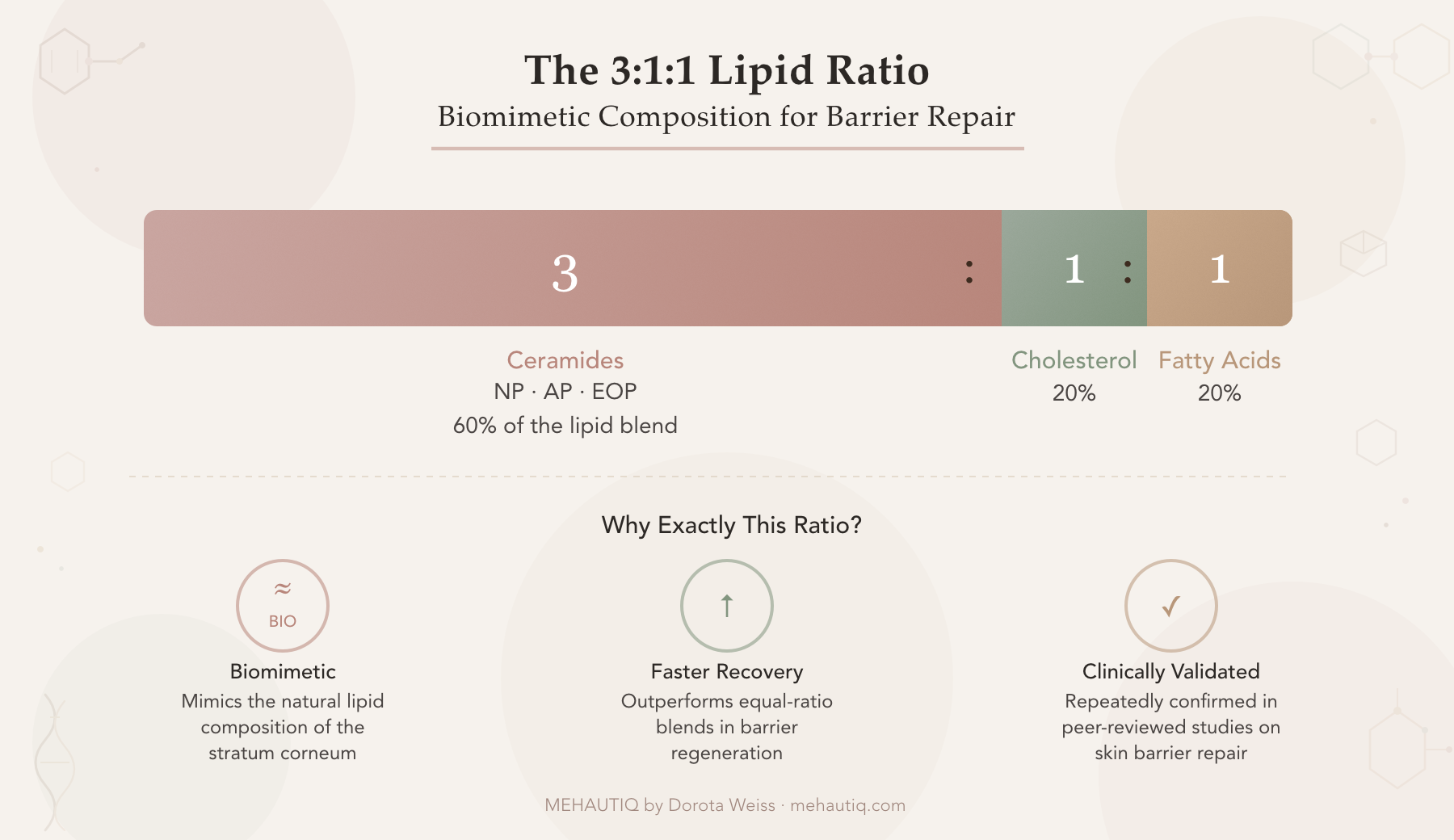
Later research expanded this into a range rather than a single magic number. Formulas where ceramides still dominate but cholesterol is present—such as 3:1:1:1 * or 3:2:1:1 **—have achieved over 90% barrier repair in experimental models within hours. The consistent finding is not “exact ratio or nothing,” but:
Complete lipid families in the same jar outperform incomplete ones.
For menopausal skin, where specific ceramides have dropped and changed quality, this completeness matters even more than it did a decade ago. If you have been layering multiple single-ingredient products hoping they will combine into something effective, the research suggests that pre-combined, physiologically-proportioned lipids work better because the ingredients are already structured to interact.
The ceramides your skin misses most
Menopause does not shrink ceramide levels uniformly. Three types in particular decline more sharply than others, and those are strongly linked with barrier strength.
- Ceramide NP–the most abundant ceramide in healthy skin; central to water retention and barrier integrity.
- Ceramide AP–helps organize the lipid layers, supporting a smooth, ordered structure.
- Ceramide EOP–crucial for building long, well-stacked lamellae (the layers in your mortar) and often shows the steepest decline in damaged skin.
If a product claims to support the barrier but never includes NP, AP, or EOP, it may still be a decent moisturizer, but it is unlikely to address the specific patterns your menopausal skin is now dealing with. You are not being too picky when you look for these on a label. You are matching product formulation to biological reality.
Reading Ingredient Lists Like a Probability Game, Not a Promise
Standing in front of a wall of products, it is tempting to look for a “perfect” label that guarantees success. Ingredient lists cannot offer that. What they can give you is a probability: Does this formula even have the right families of ingredients in meaningful ways?
A few ground rules help keep expectations realistic.
The First Few Ingredients Are The Base, Not The Whole Story
Regulations require ingredients above 1% to be listed in descending order of concentration. Below 1%, brands can list them in any order. Ceramides are highly active at low levels and usually sit below 1%, which means:
- They will almost never appear in the first five ingredients.
- They might sit lower down the list and still be at an effective concentration.
If you have scanned an ingredient list thinking, Why are the only words I care about buried near the end?, you are simply encountering how the rules are written, not failing to choose correctly.
Spotting “complete” lipid thinking
Instead of hunting for a single magic word, look for patterns that suggest the lipid triangle is present and being taken seriously.
Hints that a formula thinks in complete lipids:
- The ingredient list includes at least one ceramide (ideally NP, AP, EOP), plus cholesterol, plus identifiable fatty acids such as stearic acid, palmitic acid, or linoleic acid.
- Ceramides are not standing alone next to plant oils with no cholesterol in sight.
- Marketing language talks about “physiological lipids” or “skin-identical lipids” rather than solely “ceramides” in isolation.
One clinical trial illustrates why this pattern matters. Two emollients were compared over 28 days: one with glycerin plus physiological lipids (ceramides, cholesterol, fatty acids), and one with glycerin alone. Both hydrated the skin. Only the lipid-rich formula:
- Reduced water loss through the skin by around 17%.
- Increased key ceramides NP and AP by roughly 19–24% in the outer layer.
Glycerin alone made skin feel less dry. The lipid blend changed what the barrier was made of.
Ceramide Percentages: when numbers help and when they mislead
If you have stared at “1% ceramides” on a box wondering whether it is genuinely better or just more expensive, you are not alone.
Formulation data and industry guidelines point to a broad effective window:
- 0.2–0.5% ceramides–usually enough for maintenance in otherwise healthy skin.
- 0.5–1%–a common target for barrier repair.
- 1–2%–used for very dry, compromised, or post-menopausal skin in more intensive products.
Regulatory filings suggest that leave-on skincare often tops out around 0.2–0.7% ceramides, even when claims sounds very bold.
Two practical points matter more than the exact percentage:
- A modest ceramide level combined with cholesterol and fatty acids can outperform a high ceramide percentage used in isolation.
- Published percentages often refer to the raw ceramide blend, not the final active ceramide content in your jar.
Treat the numbers as rough tiers—maintenance versus repair versus intensive—rather than a precise dosing target you must hit. That shift alone can take pressure off reading claims, especially when you are already juggling hormonal changes, sleep, and real life.
Hyaluronic Acid Layers: Why “Hydrating” Suddenly Feels Inadequate
Many women in their 40s and 50s notice a quiet betrayal: the hyaluronic acid serum that once left their skin plump now feels like it does almost nothing. The ingredient has not changed. The context around it has.
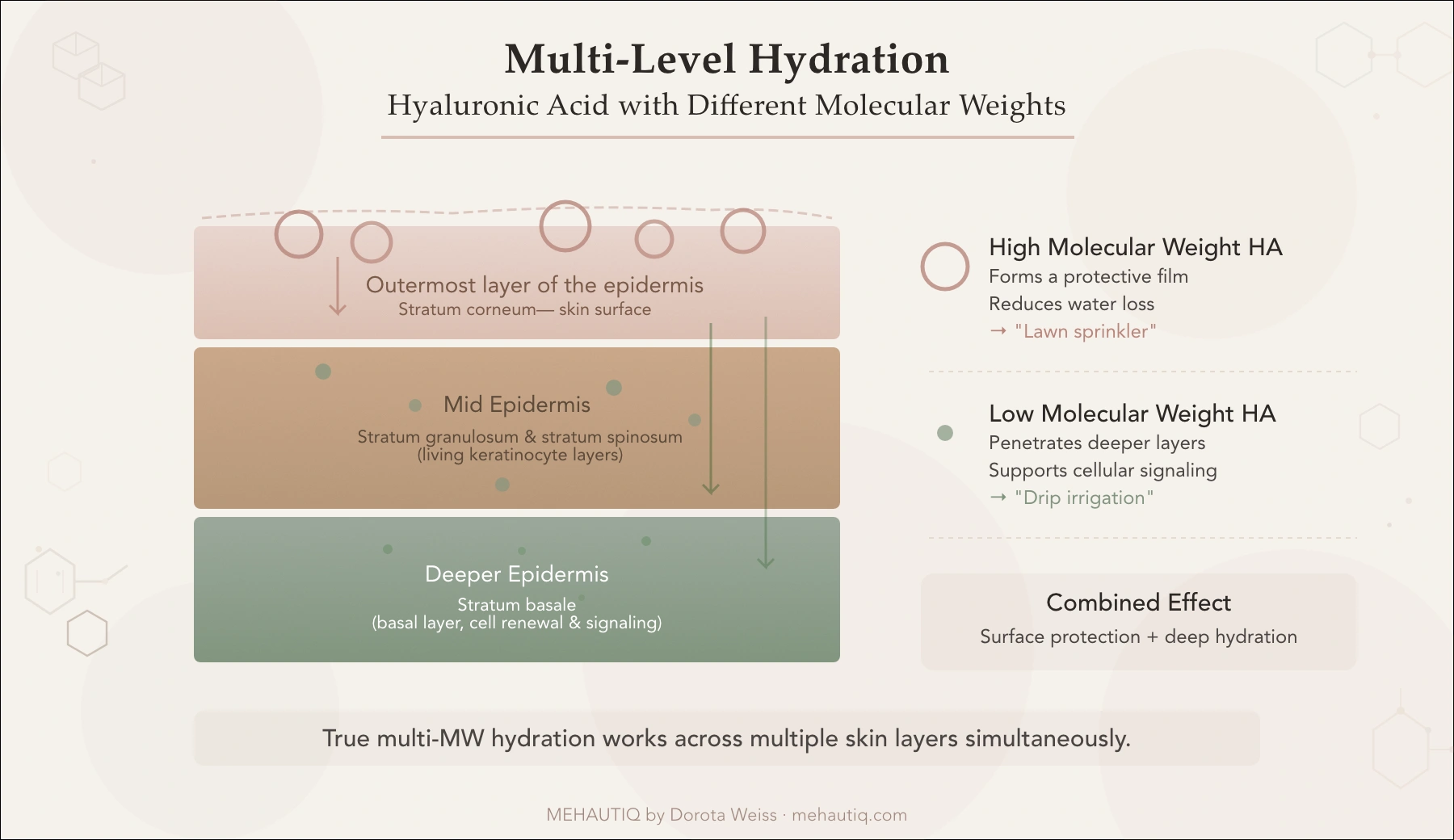
Hyaluronic acid comes in a wide range of molecular weights. That size determines how far it can move into the skin and what kind of help it provides:
- High molecular weight (HMW) HA–large chains (around 1,000–1,400 kDa) mainly stay near the surface. They form a light, flexible film that smooths and reduces water loss but do not move deeply into the epidermis.
- Low molecular weight (LMW) HA–much smaller fragments (often below 300 kDa) can travel further into the outer and middle layers of skin, where they influence cell behavior, collagen production, and barrier proteins like filaggrin.
Studies using skin models and Raman spectroscopy show that roughly 60% of HA’s penetration ability is explained by its molecular weight. After 24 hours, lower-weight forms can reach deeper layers with penetration efficiencies around 63–78%, while much larger forms mostly remain near the surface.
Think of this like insulating a house. You need weather stripping around the doors (surface protection), insulation in the walls (mid-level moisture retention), and a well-sealed foundation (deeper structural support). Using only weather stripping leaves you feeling cold no matter how much you apply. In the same way, formulations that combine different HA weights—surface film plus mid-level cushioning plus deeper signaling—tend to give more robust, longer-lasting results than a single form alone.
Clinical work with serums containing both high and low molecular weight HA has shown improved hydration and elasticity, reduced wrinkle depth, and visible softening of fine lines over several weeks.
In menopausal skin—where natural HA and collagen are already declining—the “surface only” approach of purely high-molecular-weight HA is less satisfying. The surface feels smoother for a while, but the underlying dryness and creasing remain.
Clues that a formula uses layered HA
Most labels will not list exact molecular weights, but you can look for patterns:
- Multiple HA-related names in one formula, such as sodium hyaluronate, hydrolyzed hyaluronic acid, sodium hyaluronate crosspolymer.
- Phrases like “multi-molecular weight hyaluronic acid” or “different sizes of hyaluronic acid” in the product description.
This still does not guarantee perfect layering, but it shifts the odds toward a complete hydration system rather than a single thin coat.
When You Cannot See the Most Important Part of the Formula
Even the best label reading has limits. Two jars can list almost identical ingredients and behave very differently on your skin. A big part of that difference lies in how difficult ingredients such as ceramides are handled during manufacturing.
Ceramides are waxy, poorly soluble molecules. They need to be properly dissolved at high temperatures, stabilized in the right mix of oils and emulsifiers, and cooled in a controlled way so they form flexible lamellae rather than rigid crystals.
Experimental work on skin models shows a stark contrast:
- Lamellar ceramide systems (where ceramides are fully dissolved and organized into skin-like layers) restore barrier function, reduce inflammation, and improve cell survival after chemical damage.
- Crystalline ceramides (where they recrystallize rather than forming lamellae) offer little or no barrier repair and can even worsen some markers of barrier health.
Most women discover this gap the hard way: buying a cream that seemed perfect on paper and barely moving the needle on tightness or redness.
From your perspective as a consumer, this is unsettling: you cannot see any of this by looking at the label or texture alone. Instead of trying to out-guess the lab, it is more realistic to treat these invisible factors as reasons to:
- Favor brands that share clinical data on the final product, not just individual ingredients.
- Pay attention to packaging that protects sensitive lipids—for example, airless pumps and opaque bottles rather than wide-open jars.
- Notice how your own skin responds over weeks, not days, and give yourself permission to stop using something that looks “perfect on paper” but simply does not deliver.
pH Balance: The Quiet Amplifier of Irritation After 40
Alongside lipids and humectants, the acidity of your skin surface quietly controls a network of enzymes, lipids, and microbes. Healthy facial skin normally sits in a slightly acidic range (around pH 4.5–5.5).
Think of your skin’s pH like the chemistry of a swimming pool. When the water is slightly acidic and balanced, the chlorine works efficiently, algae stays under control, and the water feels comfortable. When the pH drifts too alkaline, the chlorine becomes less effective, irritation increases, and the pool requires constant correction. Your skin operates the same way. Within the healthy acidic range:
- Key enzymes produce ceramides and other barrier lipids effectively.
- Beneficial bacteria thrive, helping keep potential pathogens in check.
- Irritation and inflammation are kept subdued.
When the surface becomes more alkaline—through harsh cleansers, high-pH products, or impaired barrier—several things happen at once:
- Enzymes that break down proteins and lipids become overactive.
- Lipid production is disrupted.
- Inflammation and itch are more likely.
- The microbiome shifts in less favorable directions.
Ceramides themselves are most stable and effective in the same slightly acidic window, and hyaluronic acid degrades more quickly at very high or very low pH.
If a cleanser you trusted for a decade suddenly leaves your cheeks shiny-tight and hot within minutes, that is often pH and barrier vulnerability working together, not you becoming “dramatic.” Your dermatologist might say, “Let’s simplify your routine,” but what does that actually mean when every product claims to be gentle?
You do not need to obsess over exact numbers on every label, but there is a practical pattern here:
- Daily leave-on products that mention being “pH-balanced to skin” or list a range around 4.5–5.5 are more likely to support your menopausal barrier.
- High-foaming, strongly alkaline cleansers and frequent use of very high-pH products make it harder for your skin to stabilize.
Timeframes, Seasons, and Expectation Management
One of the most exhausting parts of midlife skincare is not knowing whether you should “give it more time” or admit something is not working. The science cannot give exact dates for an individual face, but it does offer some ranges.
Clinical work with barrier-supporting moisturizers and lipid-rich formulas suggests:
- Within about one week, many participants report and show visible improvements in dryness and surface hydration.
- Over two to four weeks, measurements often show better barrier integrity and reduced water loss, sometimes around 17% lower transepidermal water loss in well-designed studies.
- Over four to five weeks and beyond, deeper shifts in lipid composition, such as increases in long-chain fatty acids, begin to appear.
At the same time, there is genuine variability. Genetics, other skin conditions, climate, medication, and the rest of your routine all modulate how quickly your barrier responds.
Seasons add another layer. Even in younger skin, ceramide levels drop in autumn and winter, with shorter chains and more water loss—particularly on exposed areas like the face. For menopausal skin already operating with altered lipid profiles, this seasonal dip is more noticeable.
In practice, this often works better than chasing the “perfect” schedule:
- Give a barrier-focused routine four to six weeks before making major judgments, unless you see clear signs of irritation or breakouts.
- Expect to need richer lipids or more frequent application in colder, drier months, and slightly lighter textures or lower ceramide levels in humid summers.
- Use your skin’s own signals—less tightness, fewer sudden stingy moments, fewer dehydration lines—as evidence that the barrier is genuinely improving, not just feeling coated.
If this feels overwhelming when you are already managing brain fog, sleep disruption, and the emotional weight of menopause, that reaction is entirely reasonable. You are not failing at skincare. You are navigating a molecular shift that most products were not designed for.
A Calmer Way to Judge Barrier-Repair Claims
When everything is shouting at you from the shelf, it is easy to slip into product hunting as a part-time job. Reframing how you look at barrier-repair claims can make the whole process gentler.
Does this formula think in complete lipids?
Look for at least one ceramide plus cholesterol plus identifiable fatty acids, knowing that the trio matters more than any one star ingredient.
Is hyaluronic acid treated as a layered system or a single buzzword?
Multiple HA names or mentions of different sizes suggest the brand is aiming for both surface comfort and deeper support.
Is the pH likely to support or fight against my barrier?
Daily products close to skin’s natural acidity are kinder to an already-stressed menopausal barrier.
Is there any sign that the final product—not just the ingredients—has been tested?
Claims linked to specific timeframes, measurements of water loss, or changes in ceramide profiles point to more than marketing language.
None of these guarantees that a cream or serum will feel right on your face. But they shift the process from guessing to reasoning—and from blaming your skin to understanding it.
Your skin at 50 does not need to behave like it did at 30 to be healthy. It needs building blocks that match its new reality, room to adjust across seasons, and a routine that works with the barrier rather than around it.
Note:
* 3:1:1:1 – 3 parts Ceramides: 1 part Cholesterol : 1 part Essential Fatty Acids (EFAs) : 1 part Non-Essential Fatty Acids (NEFAs)
** 3:2:1:1 – 3 parts Ceramides: 2 part Cholesterol : 1 part Essential Fatty Acids (EFAs) : 1 part Non-Essential Fatty Acids (NEFAs)

Researched and written for MEHAUTIQ by Dorota Weiss
Cosmetic formulator trained at Formula Botanica (Advanced Diploma in Organic Cosmetic Science), with an academic research background. Every article is built on peer-reviewed studies read at source, and says plainly where the evidence ends.
Literature
Core Comprehensive Reviews on Menopause and Skin
- Kendall AC, et al. Menopause induces changes to the stratum corneum ceramide profile that are prevented by hormone replacement therapy. Scientific Reports, 2022; 12:21715.
- Yazdanparast T, Ayatollahi A, Samadi A, Sabzvari A, Kafi H, Firooz A. Safety and Efficacy of a “High and Low Molecular Weight Hyaluronic Acid Hybrid Complex” Injection for Face Rejuvenation. J Cosmet Dermatol. 2025 Apr;24(4):e70117. doi: 10.1111/jocd.70117
- Giardina S, Poggi A. Skin penetration ability of 12 hyaluronic acids with different molecular weights after topical application. JOJ Dermatology & Cosmetics, 2023; 5(3):555665.
- EMJ Reviews. Update on low-molecular-weight hyaluronic acid in dermatology: a scoping review. EMJ Dermatology, 2024.
- Karabat MU, Tuncer MC. Effects of hyaluronic acid on skin at the cellular level: a systematic review. Rev Assoc Med Bras (1992). 2025 Sep 19;71(8):e20250208. doi: 10.1590/1806-9282.20250208.
- Chmielewski R, Lesiak A. Mitigating Glycation and Oxidative Stress in Aesthetic Medicine: Hyaluronic Acid and Trehalose Synergy for Anti-AGEs Action in Skin Aging Treatment. Clin Cosmet Investig Dermatol. 2024;17:2701-2712, https://doi.org/10.2147/CCID.S476362
- Bourguignon LY. Matrix hyaluronan-activated CD44 signaling promotes keratinocyte activities and improves abnormal epidermal functions. Am J Pathol. 2014 Jul;184(7):1912-9. doi: 10.1016/j.ajpath.2014.03.010.
- Paul V Andrew, et al. Topical supplementation with physiological lipids rebalances the stratum corneum ceramide profile and strengthens skin barrier function in adults predisposed to atopic dermatitis, British Journal of Dermatology, Volume 193, Issue 4, October 2025, Pages 729–740, https://doi.org/10.1093/bjd/ljaf200
- Schild J, et al. The role of ceramides in skin barrier function and the importance of their correct formulation for skincare applications. International Journal of Cosmetics Science 2024;46:526–543. https://doi.org/10.1111/ics.12972
- Janssens M, et al. Increase in short-chain ceramides correlates with an altered lipid organization and decreased barrier function in atopic eczema patients. J Lipid Res. 2012 Dec;53(12):2755-66. doi: 10.1194/jlr.P030338.
- Zwara A, Wertheim-Tysarowska K and Mika A (2021) Alterations of Ultra Long-Chain Fatty Acids in Hereditary Skin Diseases—Review Article. Front. Med. 8:730855. doi: 10.3389/fmed.2021.730855
- Murphy, B., Grimshaw, S., Hoptroff, M. et al. Alteration of barrier properties, stratum corneum ceramides and microbiome composition in response to lotion application on cosmetic dry skin. Sci Rep 12, 5223 (2022). https://doi.org/10.1038/s41598-022-09231-8
- Del Rosso JQ, Kircik L. Skin 101: Understanding the Fundamentals of Skin Barrier Physiology-Why is This Important for Clinicians? J Clin Aesthet Dermatol. 2025 Feb;18(2):7-15.
These are non-peer-reviewed but commonly used for formulation, nomenclature, or technical guidance:
- Personal Care Products Council. INCI nomenclature: ceramide naming conventions. PCPC Technical Guidance, 2021.
- INCIDecoder. How to read an ingredient list. INCIDecoder Educational Resource. https://incidecoder.com