Part 2 of the Barrier Repair Series — the first three weeks of a ceramide barrier-repair experiment through a Northern European winter. Early data, an unexpected plateau, and what comfort signals before appearance catches up.
The first application was a Tuesday evening in early December. I pressed one pump into my palm, spread it across my shin, and waited.
The cream absorbed within about two minutes — no residue, no greasy film. My skin felt immediately comfortable in a way that caught me off guard: not dramatically different, just quieter. Like the low-level hum of an appliance you only notice once it stops.
If you have been living with dry, reactive skin through perimenopause or menopause, you may know this sensation. Not the tightness itself, but the background awareness of it — the way you unconsciously avoid gripping things too firmly, or register the pull of fabric against your shin without consciously thinking about it. When that background noise goes silent, even briefly, it gets your attention.
“I didn’t expect to notice anything this soon,” I wrote in my testing notes that first evening. “The research says not to. But the silence is hard to ignore.”
The Experiment in Brief (For When You Are Skimming Between Meetings)
- Comfort improves within the first week — but this reflects hydration, not structural repair.
- True barrier repair takes 4–6 weeks minimum; longer in menopausal skin where cell turnover is slower.
- A plateau at weeks 2–3 is normal — especially in winter — not a sign the product has failed.
- When comfort holds while visible texture fluctuates, that is a positive early signal of structural repair beginning beneath the surface.
In this article
- Why Ceramide Barrier Repair Takes Longer in Menopausal Skin
- The Test Areas: Where Barrier Damage Shows Most
- How the Assessment Was Conducted: Three Methods, One Story
- Week One: The Immediate Hydration Response
- Weeks 2–3: The Plateau Phase and Why It Happens
- Reading the Data: What the Split Between Feeling and Seeing Means
- What the First Three Weeks Reveal
- Frequently Asked Questions
Why Ceramide Barrier Repair Takes Longer in Menopausal Skin
Before reporting what happened, it helps to understand what is actually taking place in the first weeks of any barrier-repair protocol — because the biology explains both the early improvements and the frustrating plateaus that follow.
Your skin renews itself in a cycle of roughly 28 days — and that cycle slows as estrogen declines during perimenopause and menopause, sometimes stretching closer to 40–45 days.
New keratinocytes form at the base of the epidermis, migrate upward, flatten, and eventually shed from the surface. Think of it as a slow conveyor belt carrying new material from the factory floor to the surface. The outermost layer — the stratum corneum — is where ceramides do their critical work, forming the lipid structure that holds water in and keeps irritants out.
When ceramide levels drop, as they measurably do during menopause — declining by roughly 30% from premenopausal levels — this structure develops gaps. Water escapes more easily. Irritants penetrate. The skin becomes reactive in ways it previously was not, and often in ways that feel sudden, even though the underlying change has been building for months or years.
Restoring this lipid structure requires new cells — cells built with the ceramides you are now supplying topically — to complete the full journey from base to surface. Structural repair takes longer, but once it is done, the water stays. In the first two to three weeks, you are largely working on cells that are already mid-journey. The real structural repair is happening in cells being built right now, which will not be visible at the surface until they arrive.
“So when will I actually see a difference?” a colleague asked when I described the protocol. My honest answer: “Probably not before week four at the earliest. The biology doesn’t allow shortcuts.”
If you want to understand why this formula was built the way it was — the lipid ratio, the delivery architecture, the pH — Part 1 of this series covers every formulation decision in detail.
This matters when you are evaluating any barrier-repair product. The comfort you feel in week one is real — but it is a hydration response. The structural change comes later. True barrier repair takes 4–6 weeks minimum. Any product promising visible barrier repair within a week is making claims the biology does not support.
The Test Areas: Where Barrier Damage Shows Most
I chose two areas where the barrier compromise was clearly visible and where you might recognise similar patterns on your own body.
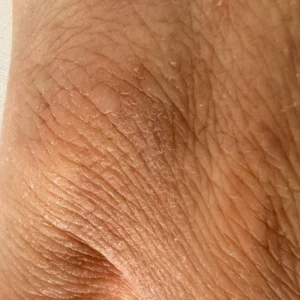
The shin showed the classic presentation that many women notice during menopause — not dramatic, not painful, but persistent. Under certain lighting, particularly against dark clothing, fine white scales were visible. There was occasional itching, particularly after bathing or in overheated rooms. That rough, slightly chalky texture that appears when the outermost skin layer is not retaining moisture effectively.
The hand presented a more acute picture. The area around the small finger 5th knuckle showed deep transverse cracks with visible flaking — large flakes, not fine surface scaling. The skin felt tight after washing. There was intermittent itching and, on some days, genuine discomfort when gripping objects. If you have experienced cracked hands in winter — the kind that make you wince when you open a jar or turn a key — you know that this is not a cosmetic concern. It affects how you move through your day.
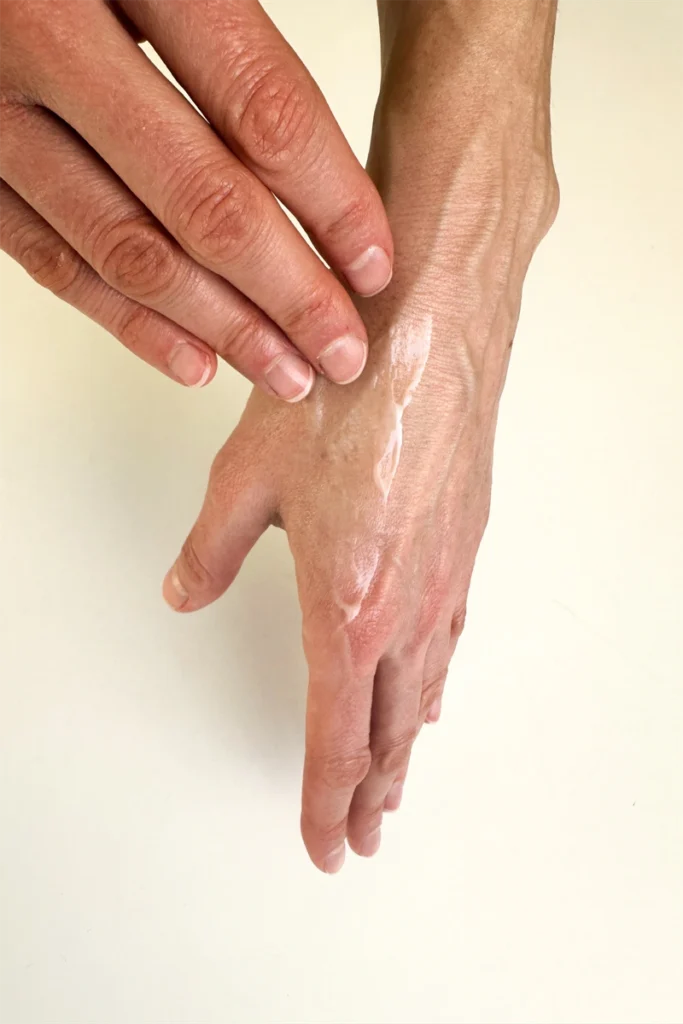
Both areas were treated once daily with one to two pumps of the formula. No other topical products were used on these areas during the eight weeks.
How the Assessment Was Conducted: Three Methods, One Story
To track changes as objectively as possible, three separate assessment methods were used in parallel throughout the test period. Each captures a different dimension of skin condition, and the overlap between them is where the most reliable conclusions come from.
The Visual Analogue Scale (VAS)
The Visual Analogue Scale (VAS) is a standard method used in dermatological research. For each parameter — dryness and flaking, roughness, tightness and discomfort, and overall skin condition — a mark is placed on a 100 mm line, where 0 represents no symptoms and 100 represents the most severe presentation imaginable. The result is a measurement in millimetres, continuous rather than stepped, which makes it sensitive to small changes that a simple 1–5 rating might miss.
The SRRC Scoring System
The SRRC Scoring System is a structured clinical grading method. Each of four visible skin parameters — scaling, roughness, redness, and cracks or fissures — is scored on a scale of 0 to 4. The scores are summed to produce a total out of 16. This method is less sensitive to subjective variation because it grades observable features rather than felt experience.
The Subjective Symptom Assessment
The Subjective Symptom Assessment records the lived experience of the skin: tightness, itching (pruritus), overall comfort, visible flaking, and smoothness, each on a 0–10 scale. Where the VAS captures a moment-in-time measurement and the SRRC grades what can be seen, this method records how the skin feels to live in day to day.
Using all three in parallel matters because a single method can be misleading. A skin that scores well on clinical grading might still feel uncomfortable. A skin that feels comfortable might still show visible flaking. The convergence — or divergence — between these three measures is what tells the real story.
Week One: The Immediate Hydration Response
Within the first few days, two things changed on the hand: the itching stopped, and the tightness after washing became markedly less noticeable. The cracks did not disappear — the skin texture remained rough to the touch — but the daily experience of having them changed. The constant background awareness of discomfort eased.
The flakes became smaller. Rather than the large, almost papery flakes of the baseline period, what shed from the surface was finer. This is what improved hydration does to the way dead skin cells release — better-hydrated cells separate more cleanly, in smaller pieces.
On the shin, the improvement was subtler but present. Fewer flakes appeared on clothing. The skin did not feel rough in the same way after bathing.
“The cracks are still there,” I noted on day five, “but they don’t announce themselves every time I pick something up. That’s not nothing.”
The Numbers from Week One
The VAS assessment on the shin recorded a sharp drop across every parameter. Dryness and flaking fell from 40 mm at baseline to 0.1 mm. Roughness dropped from 65 mm to 20 mm. Tightness and discomfort went from 56 mm to 12 mm. The overall skin condition score fell from 47 mm to 0.7 mm. These are large changes for one week, and they are consistent with a strong initial hydration response rather than structural repair.
The SRRC clinical grading told a more conservative story. The shin’s total score dropped from 5 out of 16 at baseline to 2 — scaling reduced from grade 2 to grade 1, and the cracks or fissures that had been present at baseline (grade 2) resolved entirely. Roughness remained at grade 1. This is a smaller movement, which is expected: clinical grading captures what is structurally visible, not what is felt.
On the hand, the assessment notes recorded that the skin was still rough, with one or two visible cracks remaining, but itching had stopped. The baseline had been described as visibly damaged skin with small wounds indicating cracking, accompanied by an unpleasant feeling of tightness. By week one, that tightness and itching were no longer present — even though the visible damage had not yet resolved.
I want to be careful about attributing too much to week one. Some of this improvement is almost certainly the formula reducing water loss mechanically — humectants and occlusives working immediately, independent of any ceramide integration. The structural work has not yet begun. But for anyone evaluating a new product, the first week tells you something real: whether the formula’s hydration architecture suits your skin. If comfort does not improve at all in week one, the issue may be fit, not patience.
Weeks 2–3: The Plateau Phase and Why It Happens
Around week three, something shifted. The gradual improvement on the hand slowed, and on some days there appeared to be slightly more scaling than the previous week. The itching and tightness did not return — those improvements held — but the visible texture deteriorated.
The explanation is environmental. December in Germany brought genuinely cold weather — sub-zero nights, dry indoor heating running constantly. Think of it as trying to heat a house with the windows open: the formula was working to retain moisture, but the environment was pulling it away faster than usual. Cold air holds very little moisture, and central heating strips it further. If you live somewhere with harsh winters, you will recognise this frustrating dynamic — your skin working against the season, not just against time.
“Is it going backwards?” I wrote on a particularly cold morning in late December, when the thermometer read –13 °C. “No. The comfort is holding. The flaking is the weather talking, not the product failing.”
What the Numbers Show at Weeks Two and Three
The VAS data on the shin reveals this pattern in precise terms. At week two, dryness ticked back up to 9 mm (from 0.1 mm at week one), while roughness continued to fall, reaching 4 mm. Tightness resolved entirely to 0 mm. By week three — when frosts pushed temperatures down to –13 °C — dryness held at 8 mm and roughness dipped further to 2.5 mm. Tightness crept back slightly to 2 mm. The overall skin condition score stood at 3.5 mm, still dramatically improved from the 47 mm baseline but showing the effects of the cold.
The SRRC clinical grading was even more stable. The shin’s total score dropped from 2 at week one to 1 at week two, and held at 1 through week three. Scaling remained at the lowest positive grade (1), but roughness, redness, and cracks all scored zero from week two onward. The clinical picture continued to improve even as the VAS captured the subjective experience of the weather’s impact.
Table 1: VAS Assessment — Shin (Weeks 0–3)
| Shin (Left) | Dryness & Flaking (mm) | Roughness (mm) | Tightness & Discomfort (mm) | Overall Skin Condition (mm) |
|---|---|---|---|---|
| Week 0 (baseline) | 40 | 65 | 56 | 47 |
| Week 1 | 0.1 | 20 | 12 | 0.7 |
| Week 2 | 9 | 4 | 0 | 7 |
| Week 3 | 8 | 2.5 | 2 | 3.5 |
VAS: 0 mm = no symptoms; 100 mm = most severe. Lower scores indicate improvement.
Table 2: SRRC Clinical Grading — Shin (Weeks 0–3)
| Shin (Left) | Scaling (0–4) | Roughness (0–4) | Redness (0–4) | Cracks / Fissures (0–4) | SRRC Total (/16) |
|---|---|---|---|---|---|
| Week 0 (baseline) | 2 | 1 | 0 | 2 | 5 |
| Week 1 | 1 | 1 | 0 | 0 | 2 |
| Week 2 | 1 | 0 | 0 | 0 | 1 |
| Week 3 | 1 | 0 | 0 | 0 | 1 |
SRRC: Each parameter scored 0–4 (0 = absent, 4 = severe). Total score out of 16. Lower scores indicate improvement.
On the hand, the assessment notes at week three recorded that while observable change in skin condition had occurred, the conditions had become drier — an honest acknowledgement that the environment was working against progress. Despite this, the dosage was not increased. The decision to hold the protocol steady, even through a setback, was deliberate.
This is worth noting because it reveals something important about barrier-repair research that controlled clinical studies sometimes obscure. Clinical trials are conducted in stable laboratory conditions — consistent temperature, calibrated humidity. Your skin exists in December. The gap between those environments is real, and it means that progress which looks modest compared to published benchmarks may actually represent meaningful work against a harder challenge.
I made no changes to the routine. Same quantity, same frequency, same application technique. If you are evaluating a barrier-repair product and hit a plateau around weeks two to three — particularly in winter — the temptation to switch products, increase application, or add something new is strong. Every one of those changes makes your results uninterpretable. You lose the ability to know what is working.
Reading the Data: What the Split Between Feeling and Seeing Means
Here is what these numbers show: comfort and sensitivity improved sharply in week one and largely held, even through the cold-weather setback. Visual dryness was more volatile — it responded to environmental conditions. This split between how skin feels and how it looks is a pattern worth watching in your own experience. If comfort holds while appearance fluctuates, the underlying repair may be real even when the mirror is discouraging.
The three assessment methods converge on the same narrative but from different angles. The VAS, sensitive to felt experience, recorded the most dramatic week-one improvement and also the most visible weather impact. The SRRC, which grades only what can be seen and graded clinically, showed steady improvement that was less affected by environmental fluctuation. The subjective symptom reports — particularly the disappearance of itching and the improvement in daily comfort on the hand — confirmed that the changes were not just measurable but experienced.
This convergence is precisely why three methods were used rather than one. A single VAS score might overstate improvement in week one and overstate setback in week three. The SRRC alone might understate how much the experience of the skin had changed. Together, they tell a more complete — and more honest — story.
What the First Three Weeks Reveal
The early data shows that the hydration components are performing as expected — the early comfort improvements are consistent with the hydration action of humectants and occlusives, reducing the daily experience of dryness and sensitivity quickly. The hand scores improved within the first week and largely held there even through adverse weather.
What the data does not yet confirm is whether structural barrier repair is occurring. That question requires more time. The photographs at weeks six and eight will be more informative than any number at week three.
The weather complication is, paradoxically, useful. A formula that merely hydrates would show comfort scores fluctuating in tandem with the visible texture. A formula that is beginning structural repair would show comfort holding while appearance temporarily worsens. That split — feeling better while looking the same or worse — is exactly what the data shows. It is too early to call that evidence. But it is the pattern worth watching.
If you are evaluating a barrier-repair product in winter and see a plateau or slight regression around weeks two to three, consider the environment before concluding the product has failed. Cold, dry air creates a significantly higher moisture-loss rate. A product maintaining comfort gains under these conditions may be performing better than it appears.
By Week 8, you’ll understand what makes a barrier-repair formula effective, why certain ingredient concentrations matter, how to read a formula and predict whether it’s likely to work, and what realistic timelines for barrier repair actually look like.
More From This Series
This experiment has four parts. The formula and its ingredients are introduced in Creating a Barrier-Repair Formula: My 8-Week Experiment. The mid-point results appear in Skin Barrier Repair at Week 6: What Real Progress Looks Like in Midlife Skin. The final results appear in Ceramide Barrier Repair at Week Eight: What Actually Happened on Menopausal Skin in Winter.
Frequently Asked Questions
Questions that come up most often about barrier-repair:
Why does skin feel better before it looks better during barrier repair?
In the first week, the hydration components of a barrier-repair formula — humectants and occlusives — reduce water loss immediately. This relieves tightness, itching, and discomfort before any structural repair has occurred. Structural change requires new cells to complete the full journey from the base of the epidermis to the surface. Comfort improves first. Visible texture follows weeks later.
How long does ceramide barrier repair actually take in menopausal skin?
True structural barrier repair takes a minimum of 4–6 weeks — and often longer in menopausal skin. During perimenopause and menopause, the skin cell turnover cycle slows from roughly 28 days to 40–45 days, meaning the new ceramide-rich cells being built at the base of the epidermis take longer to reach the surface where repair becomes visible. What you feel in week one is real, but it reflects hydration, not structure.
How will I know when real barrier repair — not just hydration — is actually happening?
Watch for a split between how your skin feels and how it looks. In the early weeks of barrier repair, comfort typically improves before visible texture does. If your skin feels noticeably less tight, less reactive, and less itchy — while still looking dry or rough in certain lighting — that pattern is a positive early signal. It suggests the structural repair is progressing beneath the surface in cells that have not yet completed their journey to the top. The visible change follows later, typically from week four onward.

Researched and written for MEHAUTIQ by Dorota Weiss
Cosmetic formulator trained at Formula Botanica (Advanced Diploma in Organic Cosmetic Science), with an academic research background. Every article is built on peer-reviewed studies read at source, and says plainly where the evidence ends.