A Midlife Timeline — and What the Data Actually Shows
Part 3 of the Barrier Repair Series — a real-world test of ceramide-based skincare through a Northern European winter, documented by a menopausal woman tracking her own skin.
The Experiment in Brief (For When You Are Skimming Between Meetings)
- By week 6, barrier repair becomes visible — not as a dramatic before-and-after, but as a quieter, smoother surface that holds up under stress.
- Expect a two-phase pattern: early comfort gains, a discouraging plateau around week 3, then a second wave of visible improvement as repaired cells reach the surface.
- If you are in perimenopause or menopause, add two extra weeks before judging structural change — your skin’s cell turnover is slower than what clinical studies typically measure.
- Comfort holding steady while appearance fluctuates is not failure — it is the earliest sign that structural repair is underway.
In this article
- The Moment You Notice Something Has Changed
- Weeks 4–6: When Resilience Tells You More Than Appearance
- The Ceramide Concentration Question at Mid-Point
- What This Means for You
The Moment You Notice Something Has Changed
Around week six, I looked at my hand under the bathroom light and saw something different. Not a transformation. Not anything close to those dramatic before-and-after photos. Just a quieter surface. The deep transverse cracks over my little finger joint — the ones that had been splitting open since December — were softer. The flaking had settled. The texture felt structural, not just temporarily soothed.
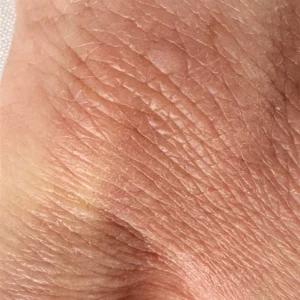
If you have been using a barrier repair product for several weeks and keep wondering, “Is this actually working, or am I just hoping it is?” — this is the stage where the answer starts to become visible. Not as a revelation. As an accumulation. The kind of change you would miss day to day but cannot deny when you compare week six to week one.
What Published Research Predicts at This Stage
Clinical trials measuring barrier function at the four-to-six-week mark show a consistent trajectory. Studies using ceramide-containing moisturisers in people with compromised barriers report transepidermal water loss — the rate at which moisture escapes through skin — dropping by roughly 15–25% at four weeks. Hydration scores typically improve by 20–35% in the same period.
You cannot measure these things at home. But the pattern is worth knowing because it predicts what your experience might feel like: rapid early improvement in comfort, a frustrating plateau (sometimes a slight step backward), then a second wave as structurally repaired cells reach the surface.
Think of it like renovating a house while you are living in it. The first week, the builders patch the most obvious holes and suddenly the draught stops — you feel better immediately. Then comes a phase where the walls look worse than before, plaster dust everywhere, and you wonder if you have made a terrible decision. But underneath, the structural work is happening. When the new walls finally go up, the improvement is real and lasting.
Week three, I genuinely asked myself: “Is this getting worse? Should I switch products?” That doubt is normal. If you felt the same thing, you are not imagining the plateau — and you are not wrong to have questioned it.
Why Midlife Skin Needs Extra Patience
Most clinical skincare studies recruit younger participants. Their published four-week benchmarks reflect a cell turnover rate of roughly 28 days. In perimenopause and menopause, declining estrogen slows turnover significantly — sometimes to 45–60 days. That means the repaired cells being built in your deeper skin layers simply take longer to reach the surface where you can see and feel them.
This is not a flaw in the product or in your skin. It is biology. If you are in your mid-forties or older, give any barrier-repair product at least six to eight weeks before assessing structural change. Judging at four weeks is like checking whether bread has risen when you have only just put the yeast in.
Practical benchmark: If your product felt better from day one and you are seeing a plateau at weeks two to four, compare comfort—not appearance—to your baseline. Comfort holding steady while visible texture fluctuates is a marker of early structural repair, not product failure. Appearance catches up.
Weeks 4–6: When Resilience Tells You More Than Appearance
The cold continued through January, but something shifted in how the skin on my hand was responding. The week-three regression—that return of larger flakes and rougher texture—did not continue to worsen. It held, then began to improve.
This distinction matters more than any single weekly score. A barrier genuinely repairing itself shows resilience: the ability to hold gains against environmental challenge, not just improve under ideal conditions. Think of the difference between a freshly painted wall and a properly sealed one. Paint looks fine in dry weather. But when the rain comes, it is the sealant that prevents damage.
By week five, tightness after hand washing—one of the most disruptive daily symptoms at the start—had been absent for weeks. The shin continued its steadier trajectory: less dramatic variation, consistent gradual improvement.
What the Numbers Show: Three Assessments Converge
Three methods tracked changes throughout this test: a Visual Analogue Scale (VAS) measuring felt symptoms, a clinical SRRC grading of visible skin features, and a subjective daily symptom log. By weeks 4–6, these three methods began telling the same story.
Table 1: VAS Assessment — Shin (Weeks 0–6)
| Shin (Left) | Dryness & Flaking (mm) | Roughness (mm) | Tightness & Discomfort (mm) | Overall Skin Condition (mm) |
|---|---|---|---|---|
| Week 0 (baseline) | 40 | 65 | 56 | 47 |
| Week 1 | 0.1 | 20 | 12 | 0.7 |
| Week 2 | 9 | 4 | 0 | 7 |
| Week 3 | 8 | 2.5 | 2 | 3.5 |
| Week 4 | 2 | 0 | 0 | 0 |
| Week 5 | 6 | 0 | 0 | 1 |
| Week 6 | 0 | 0 | 0 | 0 |
VAS: 0 mm = no symptoms; 100 mm = most severe. Lower scores indicate improvement.
The second wave arrived clearly. Roughness hit zero at week four — down from 65 mm at baseline. Tightness reached zero and stayed there. At week five, dryness briefly ticked up to 6 mm during sustained cold, but by week six every parameter scored zero. A shin that started at 208 mm registered nothing measurable.
That week-five dryness blip matters. It was the only parameter that responded to the coldest sustained stretch — roughness, tightness, and overall condition all held at zero. This is a barrier structurally intact but still thin enough for extreme cold to pull some moisture through. A very different picture from week three, when the cold affected everything.
Table 2: SRRC Clinical Grading — Shin (Weeks 0–6)
| Shin (Left) | Scaling (0–4) | Roughness (0–4) | Redness (0–4) | Cracks / Fissures (0–4) | SRRC Total (/16) |
|---|---|---|---|---|---|
| Week 0 (baseline) | 2 | 1 | 0 | 2 | 5 |
| Week 1 | 1 | 1 | 0 | 0 | 2 |
| Week 2 | 1 | 0 | 0 | 0 | 1 |
| Week 3 | 1 | 0 | 0 | 0 | 1 |
| Week 4 | 0 | 0 | 0 | 0 | 0 |
| Week 5 | 0 | 1 | 0 | 0 | 1 |
| Week 6 | 0 | 0 | 0 | 0 | 0 |
SRRC: Each parameter scored 0–4 (0 = absent, 4 = severe). Total score out of 16. Lower scores indicate improvement.
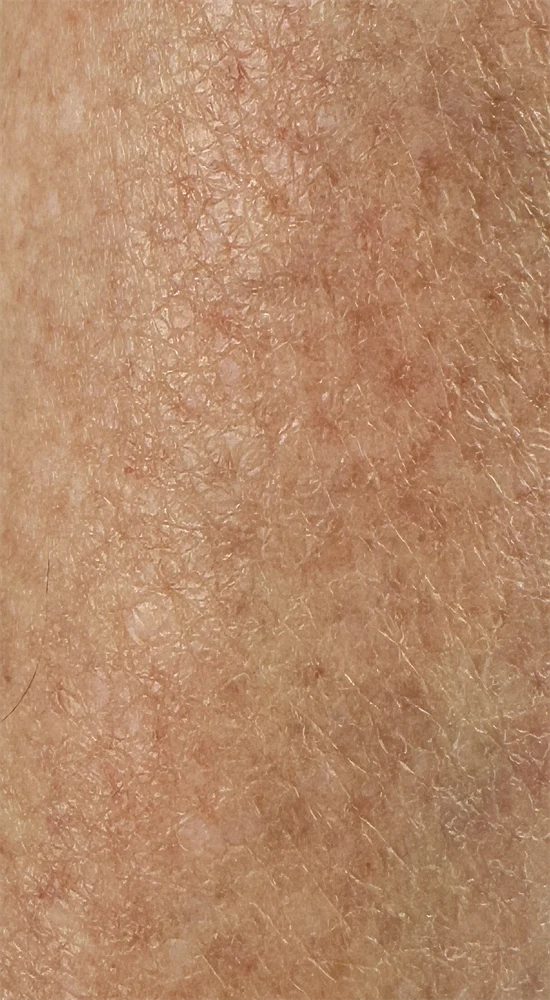
At week four, the shin scored zero out of 16 for the first time — clinically clear across every parameter. Skin that entered the test with visible scaling and cracks was showing nothing. A minor roughness score of 1 appeared at week five during the cold snap, then resolved to zero at week six.
Reaching zero, dipping to 1 under environmental stress, then returning to zero — that is exactly what resilience looks like in clinical data.
How Feeling and Seeing Finally Aligned
In the first three weeks, the VAS and SRRC told different stories — fast comfort gains versus slower visible change. That gap reflected hydration (felt immediately) versus structural repair (visible later). By weeks 4–6, the gap closed. Both scales registered near-zero. The comfort from week one was no longer just the formula on the surface — it was the barrier itself holding moisture in.
Why I Changed Nothing
Nothing in the routine changed during weeks four to six. Same formula, same amount, same once-a-day application. That restraint matters. When your skin hits a plateau at week three and every instinct says add something, do more, try another product— each of those decisions removes the one thing you actually need: clarity about what is working. In this test, once-daily use maintained comfort through temperatures well below freezing. But if you are finding that comfort holds while visible texture stalls, there is a reasonable case for moving to twice daily during the harshest weather. Clinical protocols specify that frequency for a reason — it is moisture physics.
The Ceramide Concentration Question at Mid-Point
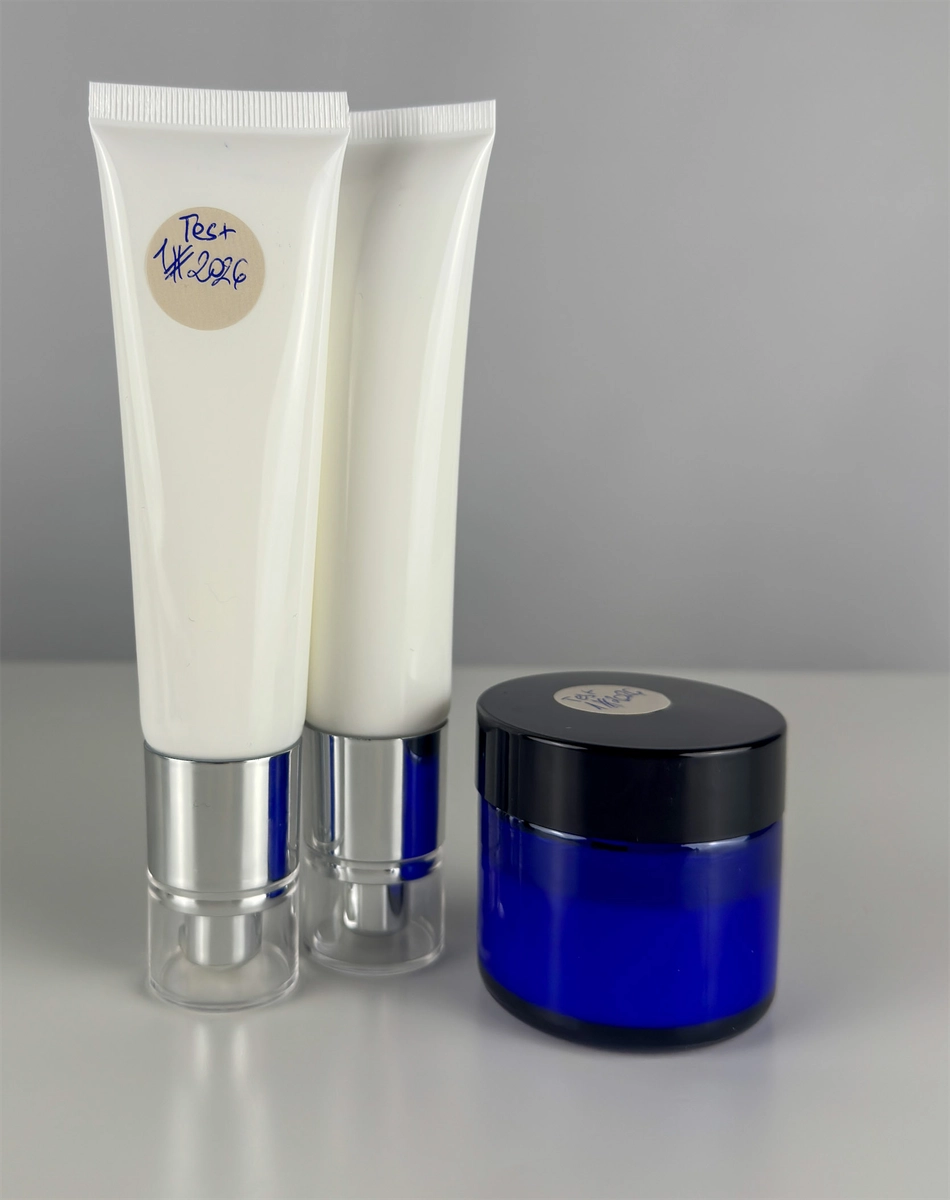
This formula contains approximately 0.1–0.15% actual ceramides—below the 0.2–2% range cited in the most robust clinical literature for barrier repair. At six weeks, the evidence is instructive but ambiguous. Comfort and sensitivity have improved substantially and held against environmental challenge. Visual texture is improving. But the rate of improvement is slower than published benchmarks using higher concentrations under controlled conditions.
The honest reading: the formula’s lamellar delivery system—a structure designed to mimic your skin’s own layered lipid arrangement—appears to be providing real benefit. But the concentration may be setting a ceiling on speed. Think of it as a well-designed irrigation network: it ensures what is there reaches the right place. But the volume of water you are sending through still matters. This is a working hypothesis that the week-eight data will test more directly.
What This Means for You
If you are in the middle of a barrier-repair journey and reading this to calibrate your own expectations, here is what I would want someone to tell me at this stage:
- The plateau is real. It is not failure. It is the transition between surface hydration and structural repair, and it resolves.
- Comfort is the leading indicator. If your skin feels better even when it does not look dramatically different yet, trust that signal.
- Menopausal skin operates on its own timeline. Add two weeks to any study timeline before assessing.
- Resist the urge to change everything. Consistency is the variable that matters most right now.
More From This Series
This experiment has four parts. The formula and its ingredients are introduced in Creating a Barrier-Repair Formula: My 8-Week Experiment. Weeks one through three are documented in The First Three Weeks of Ceramide Barrier Repair. The final results appear in Ceramide Barrier Repair at Week Eight: What Actually Happened on Menopausal Skin in Winter.

Researched and written for MEHAUTIQ by Dorota Weiss
Cosmetic formulator trained at Formula Botanica (Advanced Diploma in Organic Cosmetic Science), with an academic research background. Every article is built on peer-reviewed studies read at source, and says plainly where the evidence ends.